
Here’s Euphorbia rigida, on neglected ground near olive trees in the Peleponnese.
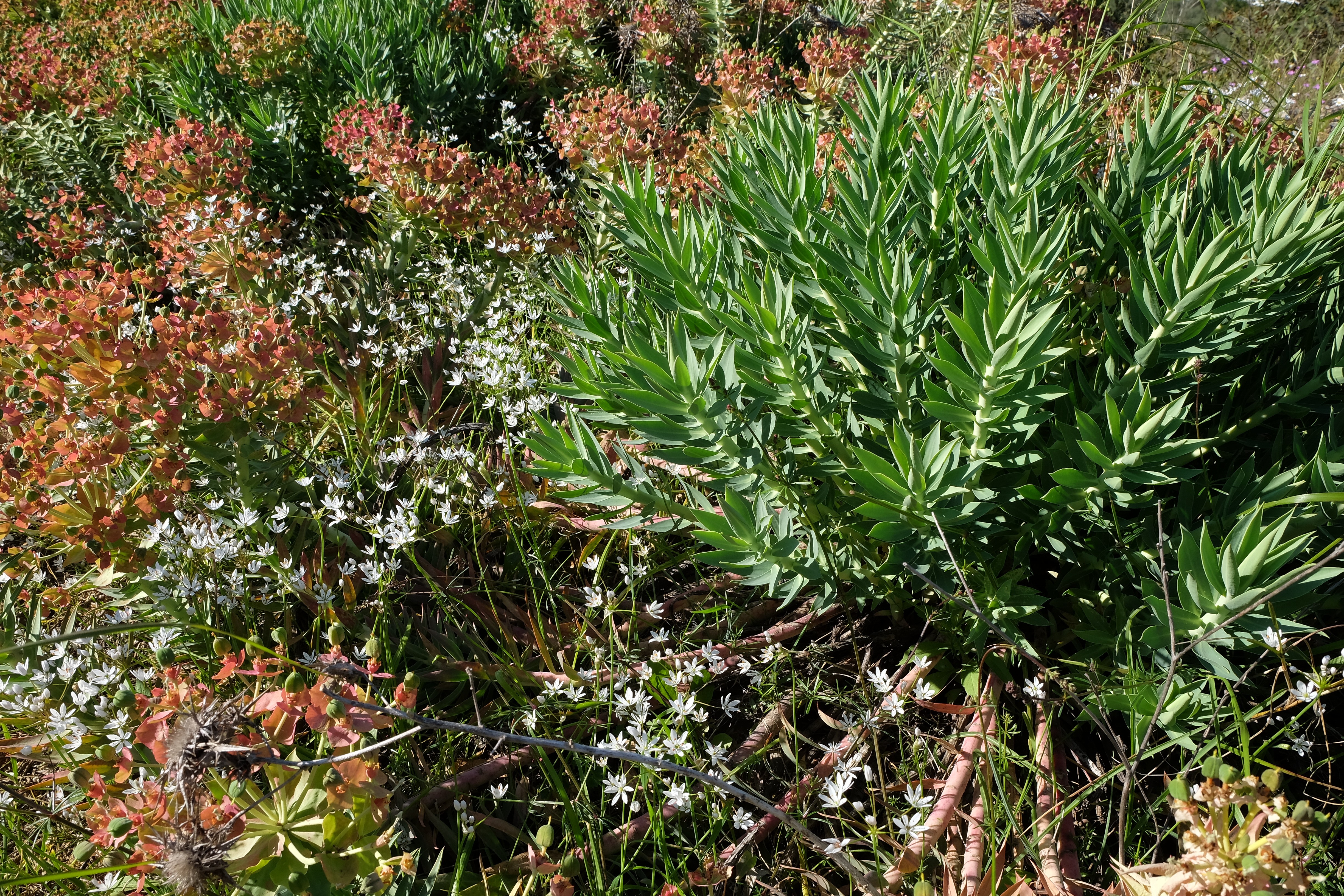
Actually, you can’t see it very clearly. I’ll see if I can come up with a cropped version.
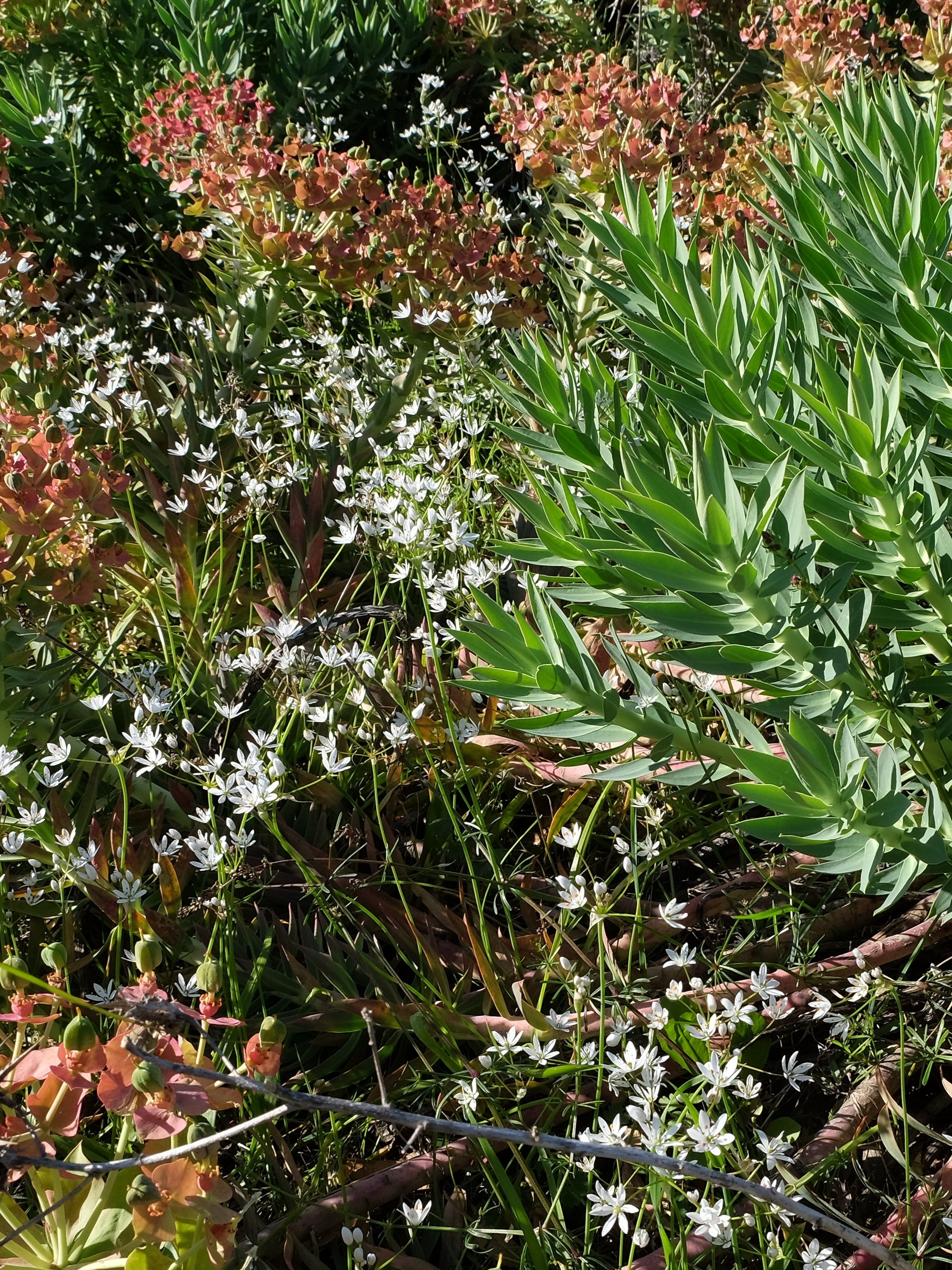
It’s April, and this early euphorbia has nearly finished flowering. The reddish flowers persist, or rather their calyx does, the outer case, with the green seed pods in the centre, but their stalks gradually subside, forming a kind of wheel at the centre of which the new shoots push up. They will flower in their turn next year. Gardeners will be familiar with this kind of pattern with, for example, Euphorbia wulfenii, a much bigger plant which blooms at the same time as E. rigida. A beautiful allium is growing through the spaces between the fallen stalks of the euphorbia.
I took that picture on one of my first visits to Greece, but took few later, because this euphorbia had ceased to be an attractive wild flower and turned nasty. It had turned into a weed. Here’s why:
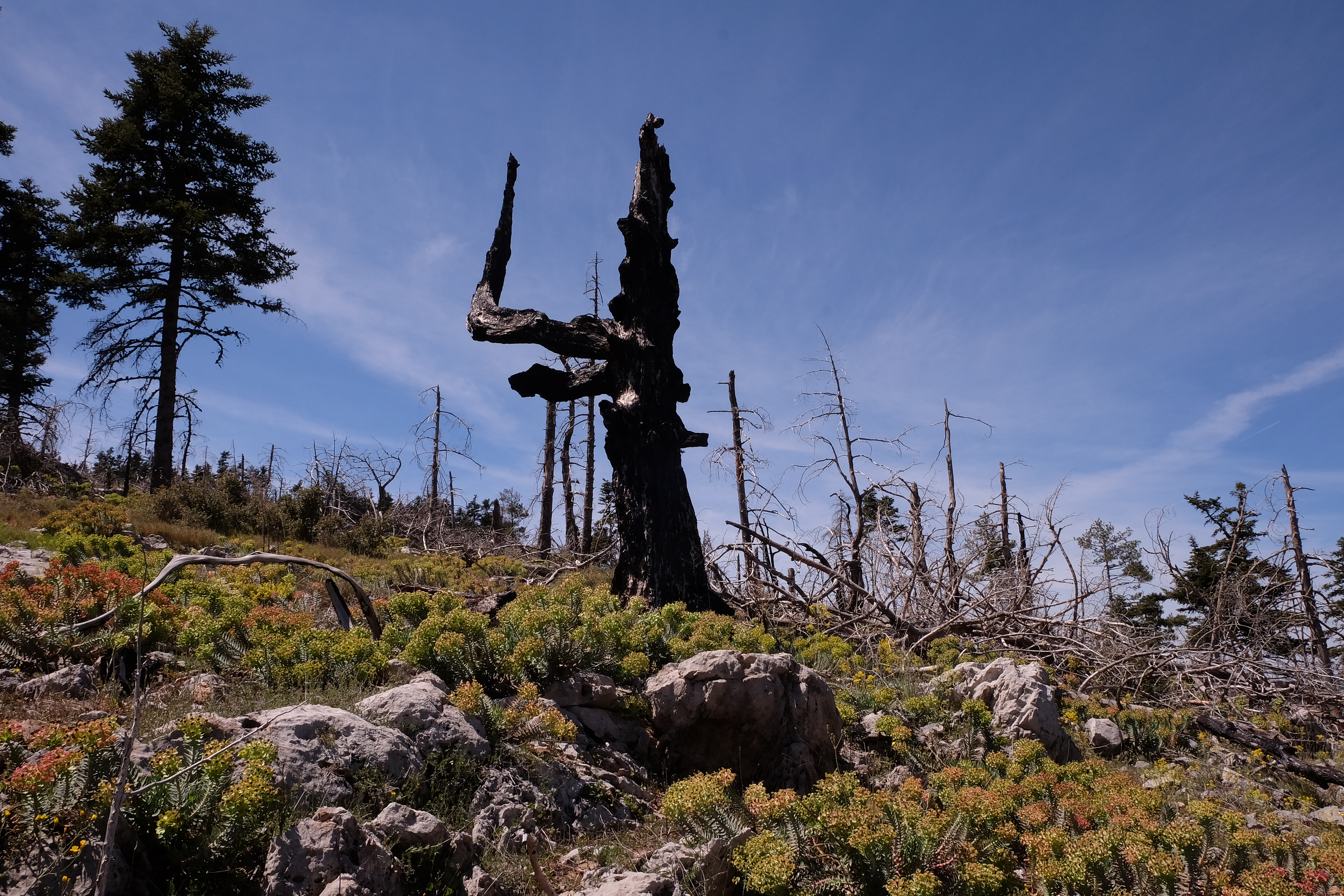
At the end of that holiday I drove back to the airport through an area of the Peloponnese called Parnonas, and found myself travelling through mile after mile of burnt out forest. I wrote about this in in the Peloponnese Nine years after the fire and in most places there was little sign of regeneration, but the euphorbias had become overwhelmingly dominant. The plants in this photo show more yellow; at a higher altitude they are flowering later.
Years later I was walking just by the side of the road which crosses the main ridge of the Taygetos mountains between Sparta and Kalamata, a main road but with little traffic. I wanted to have another look at the slowly regenerating forest which had been devasted years earlier. And I began to look again at the euphorbias, I think because I was looking at what was there rather than hoping to find special, beautiful flowers, like little orchids, among the rocks and scrub. Like the old song: If you can’t be with the one you love / love the one you’re with.
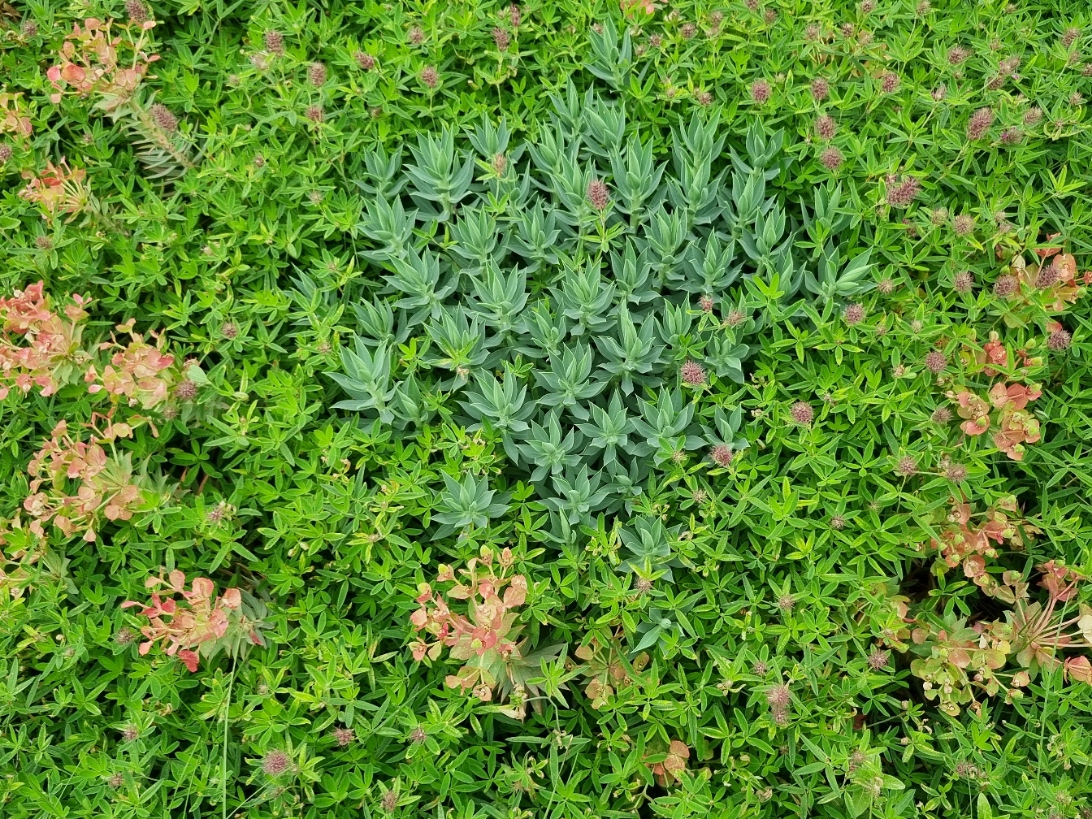
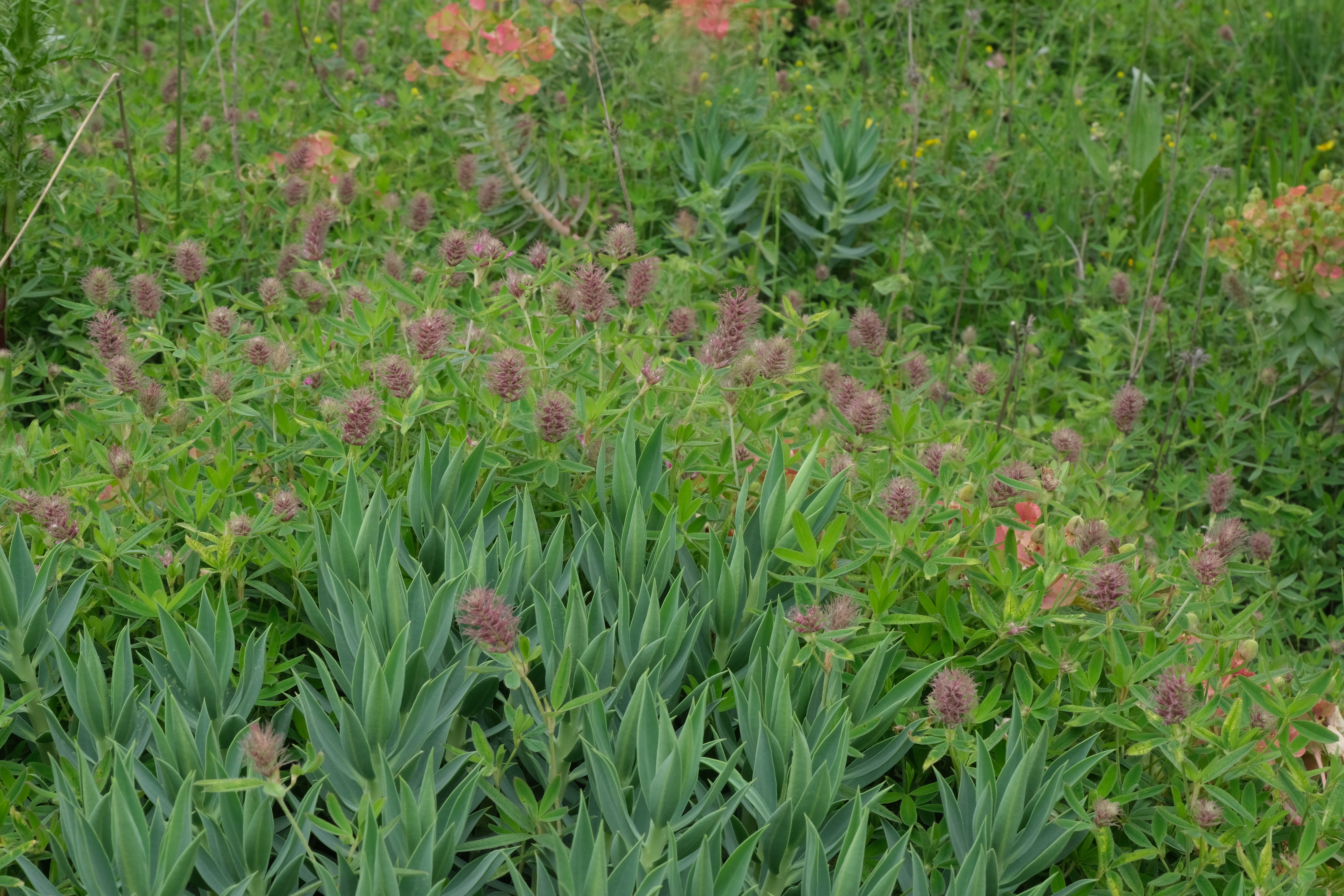
The flowers of the euphorbia are faded, their stalks buried under a carpet of clover, and their new shoots are rising up in the middle. An intricate tapestry, ‘ground cover’ that a garden designer would be content with.
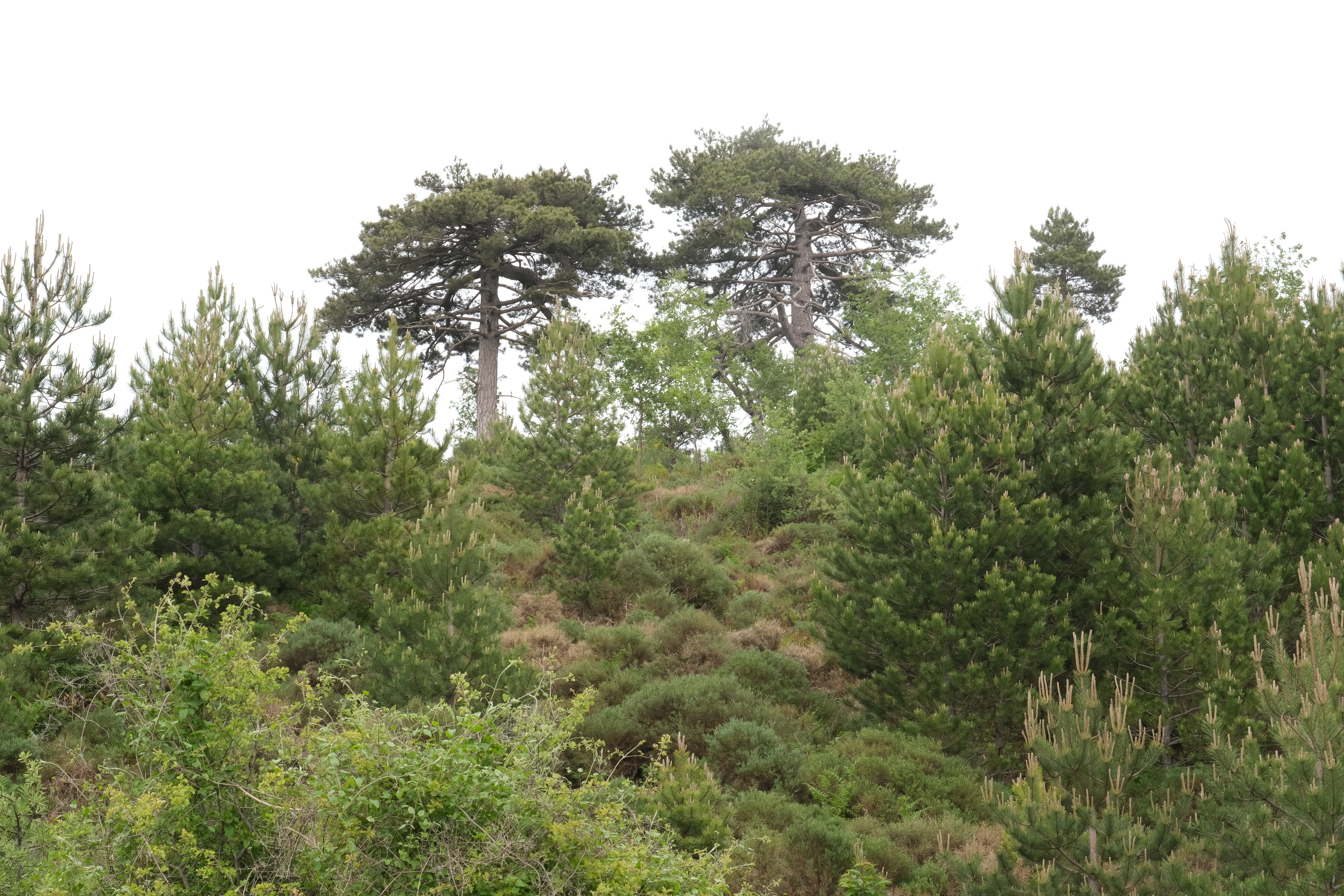
And at last the forest was returning, if slowly and patchily. But we are impatient, hoping that the devastation of a few days’ burning will be put right quickly, because we’re running out of time. Here, on a grey day, is a consoling group of young trees on that still very bare mountain, black pines and greek firs, with two survivors of the fire:
There’s a similar story about Phlomis fruticosa. I was fond of it once. We inherited it at Manor road in 1987, I’d never seen it before. It was exotic and strange and there was still a sense of excitement about being able to grow mediterranean plants. But it grew big and scruffy, it was growing in too shady a place, and couldn’t be improved by pruning. Like many shrubs – roseamary, lavender, ceanothus, for example – it doesn’t like being cut back hard into old wood so if you’re not careful with pruning in its early life, later on it develops long, bare, clumsy branches. In the end I think it just died. This next photo shows its yellow flowers by the roadside in Greece, on one of my early visits.

But I was already learning what a thug it can become, for the gardener, or in Greece where it covers abandoned and neglected fields, for the farmer. From the same trip to Greece:

And in one spot outside Anavriti, just before the path drops steeply down into the Parori gorge, I’ve seen its progress over the years, from this:
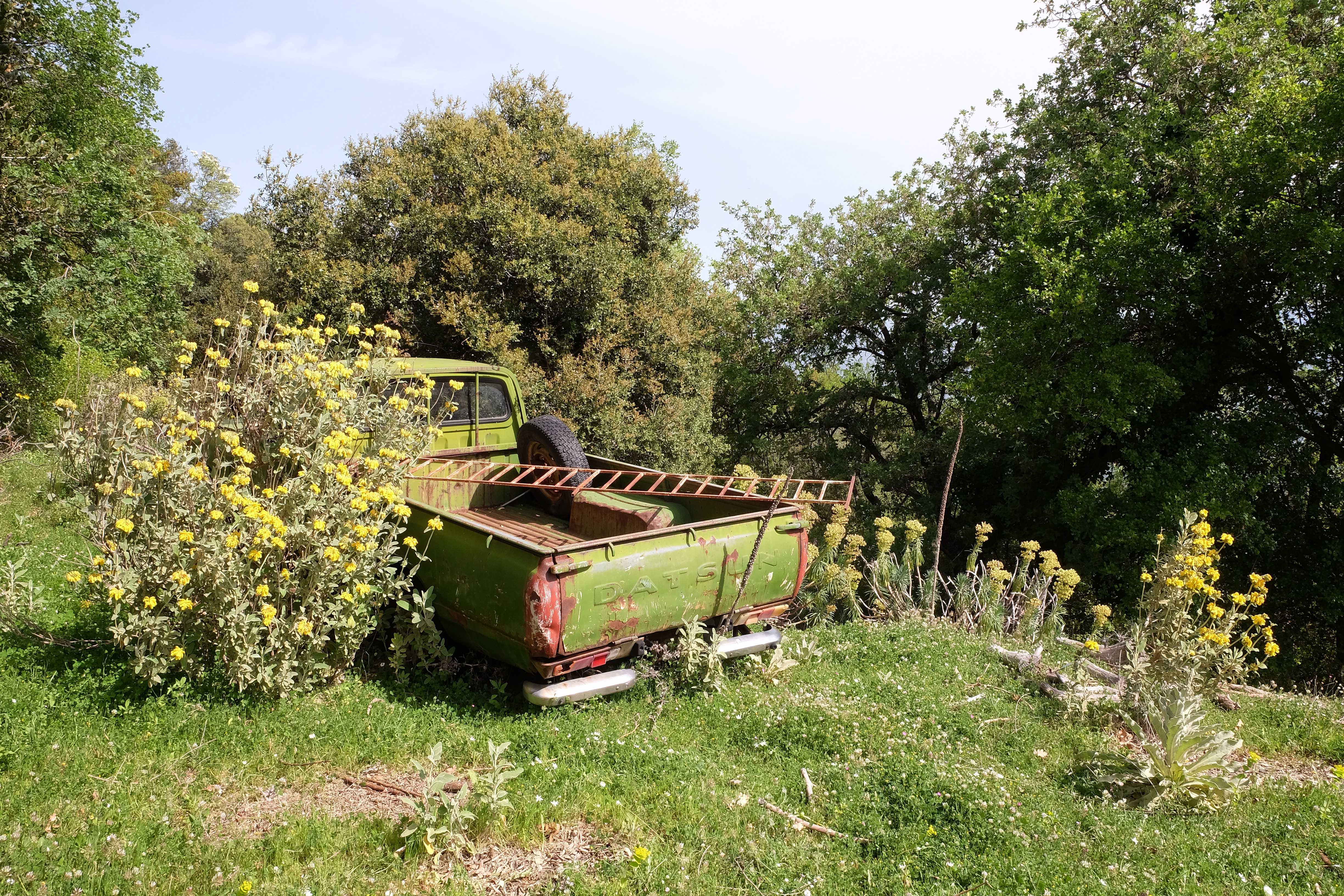
to this:
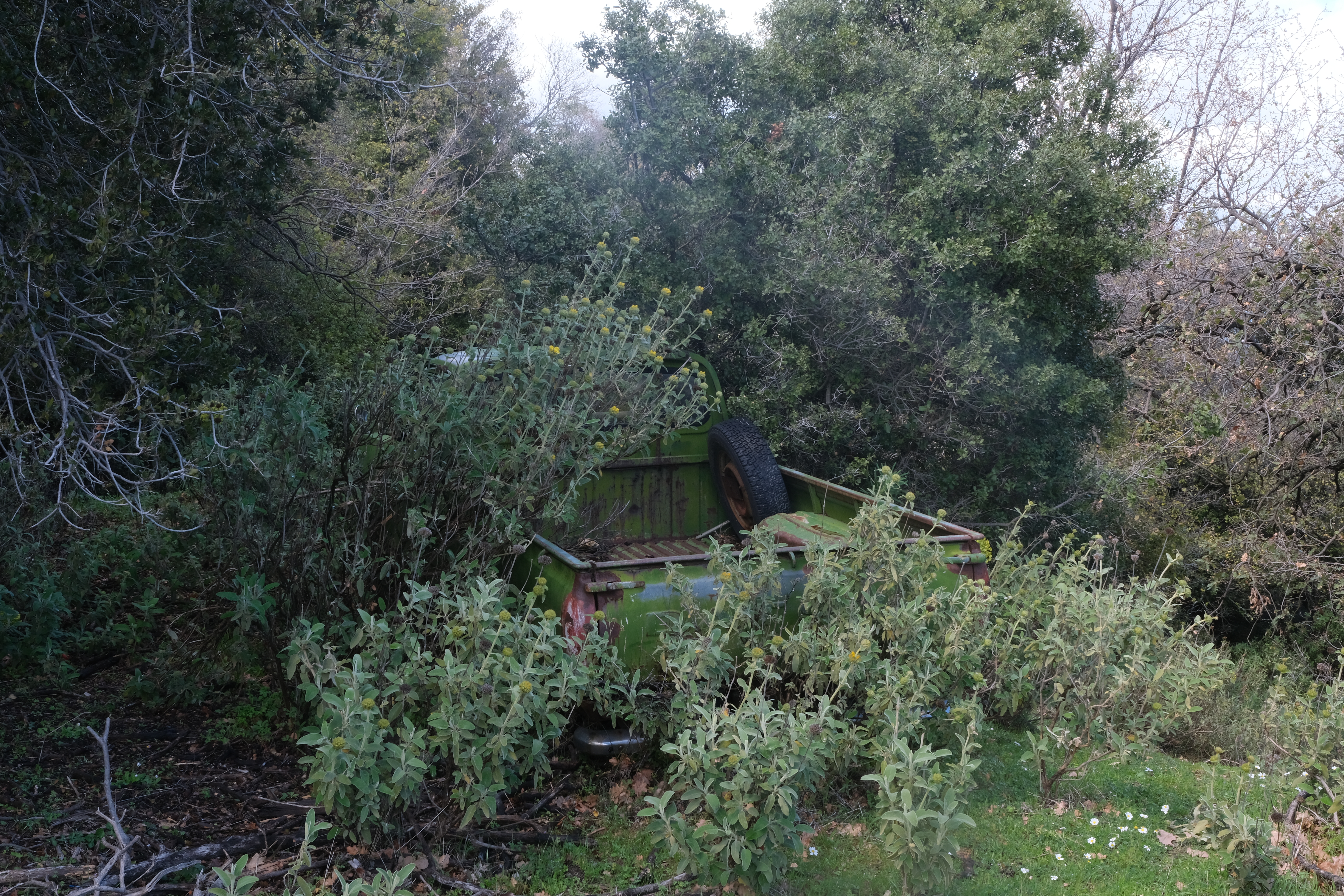
Someone finally took the ladder.
And both the phlomis and the euphorbia seem to be inedible. Goats and sheep don’t touch them. This obviously helps them to dominate. But I have seen one creature munching on a euphorbia:

In the end I began to see with fresh eyes. Several years ago when ordering plants for a dry, suny bed at St John’s, Waterloo I came across a plant called Phlomis fruticosa ‘le Sud’ which promised to be a more compact variety of the species, in the catsalogue of a nursery whose otherwise unimaginative and restricted plant list was designed for the parks and municipal landscaping market, a nursery which the London Borough of Lambeth insisted we use, as opposed to any of many smaller independent nurseries which offer a much wider range of plants. We ordered three and they began to grow quite well and I took several cuttings, only one of which lived. I have it now in a pot, and after a very slow beginning it prospers. No longer a weed, it is now associated with my own care and patience and repotting, moreover as a garden plant it seems to have fallen out of favour; I haven’t seen one on a garden for some time, butg maybe I don’t get around much any more. Whether or not it will turn out to be compact, we’ll have to see.
Wait a minute! The light was dull but when I went to take a picture of it just now I could see the first hints of colour in the flower buds and it’s not yellow at all. It must be a variety of Phlomis italica, with lilac/mauve flowers. And whether I just imagined that the catalogue said fruticosa who knows. But having just looked it up online I discover that P. ‘le Sud’ should be yellow, should be a vigorous but more compact versionof P. fruticosa. Being a servant of the written word I am too inclined to believe what I read. I can’t even give that nursery a bad review because I’ve forgotten what it’s called, and anyway, being trade only you need a password just to browse the catalogue.
See alsoAnavriti (in the Peloponnese again) for my visit to the village in 2016, and to see how I repeat myself, chew at the same old bones, and even pick from hundreds the same photos.


 like a little black book