anyway – I was going to say – in usual fashion I lay on the sofa and quickly constructed a little essay about the tulip, T. orphanidea in Parnonas – then it immediately seems like a chore to actually write it – the only new thing was, to start with the pollen beetle, which as I thought about it seemed like the monster in a children’s story, repugnant to grownups, friendly to children. The photo of the tulip sits in a corner of my framed print from a drawing of an oak by – (Mark Frith, from an exhibition at Kew Gardens called A Legacy of Oaks). see Into the past again, awkwardly: inside the tulip and into the past again, naturally: the perfect tulip?
Cool, grey – and dry. I still ‘write’ in my head, for imaginary readers, and my reluctance for the real thing grows. what was he called, the PE teacher? It was, I think, my very first PE lesson at secondary school, aged 10. He told us to put our hands on our hips, then he shouted at me, Trustram, you look like an old washerwoman! this, it turned out, was because my fingers were at the back and my thumbs at the front; it should have been the other way round. Only old washerwomen and no doubt pooftas etc. would place their fingers at the back. Try it. Try both ways round. How did it feel? Naturally I didn’t at first grasp all the many dimensions of his insult. I didn’t even know what an old washerwoman was, though I could imagine. But that image became a kind of key to unlocking complex issues of gender and identity. On the school curriculum: elementary lessons in feminism from a brute. Not only that, but because the rest of the class laughed I was taught a lesson in techniques of power and control. Unforgettable. Sixty eight years ago now! He also tried unsuccessfully to get us to play rugby in the mud. I remember him crying out Fall on the ball, fall on the ball. This must have been to get us to form a ‘ruck’. In the mud, in January. No one would. I remember him a few year later, sitting in the school yard in the sunshine, wearing only shorts, his body muscular but wizened, his leathery skin an impossible deep chestnut colour. And the strangest thing is that he was sitting on the tarmac with his back against the hot brick wall of the physics department. Everything about him was so uncomfortable. One september he never came back to school. Climbing solo, he had fallen off the Matterhorn.
Thoughts while still lying in bed this morning, from about 6 45 – last night on the radio I learnt that there were 700 lead mines in this country, some of which are slowly leaking poison. of course this has been known for a good many years. the leaks are getting worse, helped by the increase in extreme weather incidents. There’s only room for so much. I’m still thinking about my Tulipa orphanidea. The radio only has time for Trump. For the moment we’re ignoring Trump and tariffs, Trump and Epstein, Trump bossing the universities, Trump digging for oil, Trump laying claim to the Gulf of Mexico, to Greenland and Canada, Trump and his Scottish golf courses, Trump and the dream of Gaza as a strip of luxury sun-baked resorts, we have enough to be going on with with Trump and Ukraine, Trump and Putin, what should Zelensky wear to the meeting, who started it, Trump and heaven, Trump and the Nobel Peace Prize, Trump our best and biggest ally, Emperor Trump, naked bumbling Trump – now he’s saying that Ukraine started it and everybody is too polite to challenge him. The other day I saw on the BBC news website a graphic account of settlers in the west bank (squatters – illegal immigrants – thieves – vandals – terrorists – murderers – deluded fundamentalists, all those things) attacking Palestinians, destroying their houses, smashing their olive trees, while the Israeli army prevented others from coming to help them. By any standards of journalism this was a great story, but it didn’t make it on to the radio. The thing about Trump is that he takes up so much time and energy. If he turns his attention again to Gaza, then so will we.
That’s not how it was. Again came Victor Klemperer, only I’d forgotten his name. Why him? Armed forces day on the Green. The shrivelled grass was the colour of desert sand, appropriately, since the chief strength of the British armed forces and their supporters is an unshakable nostalgia for the second world war and its chief glory, with no americans anywhere near, the North Africa campaign. A friendly man was showing off his SAS jeep, as used by the fifth army in the North Africa campaign. He and his helpful, elegant wife were both colour coded for the desert. As was the cathedral, I now see.
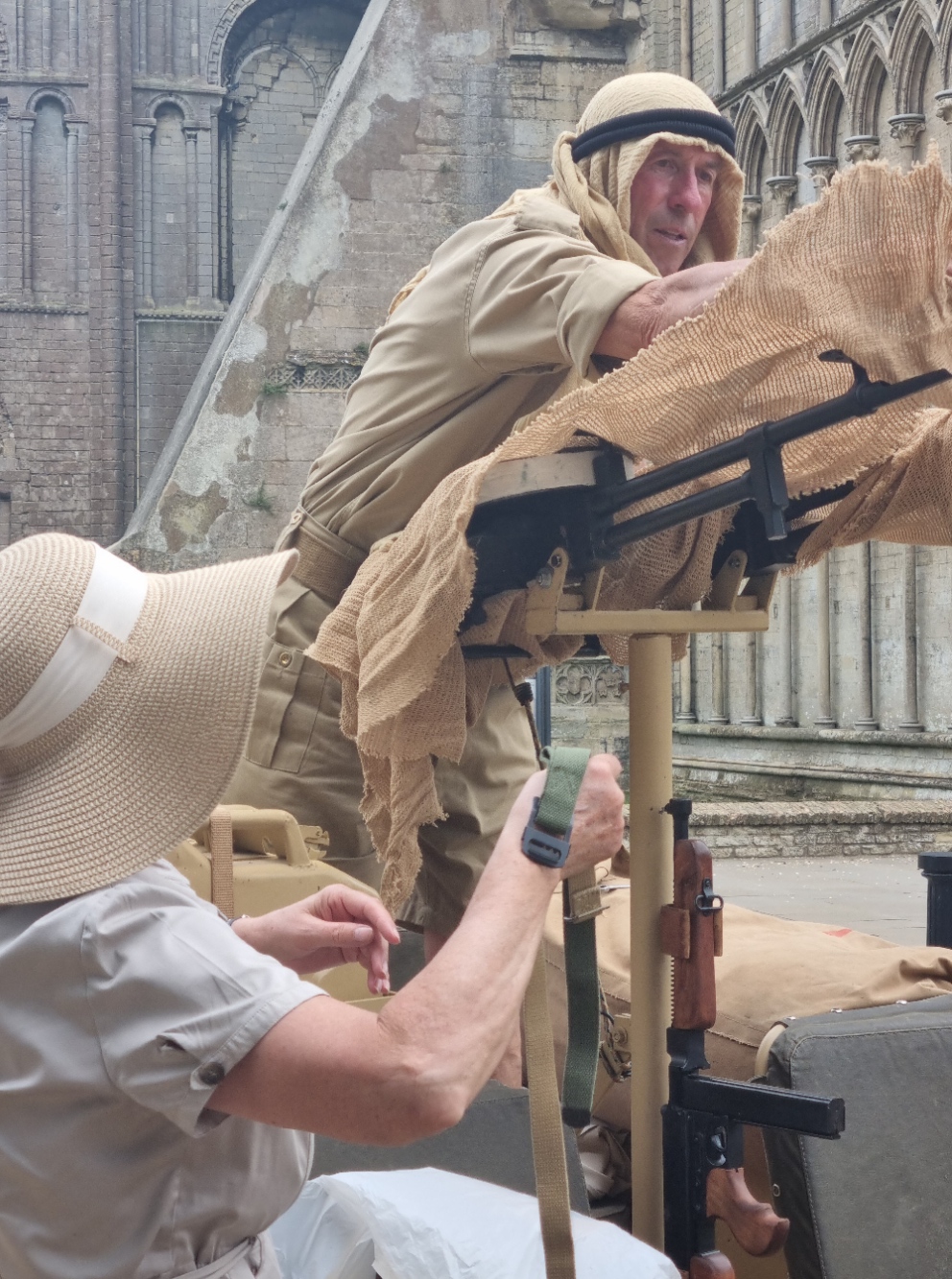
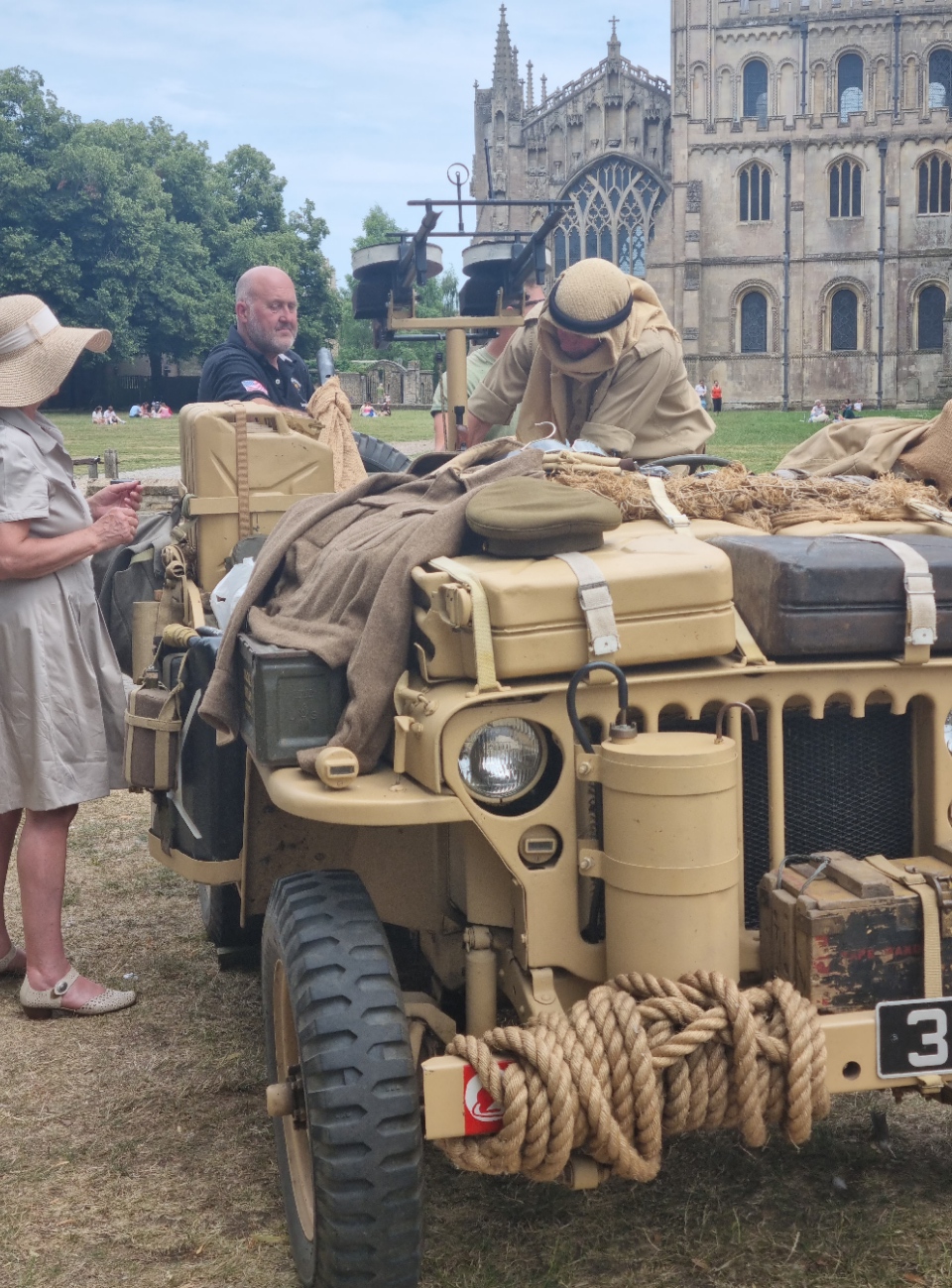
I enjoyed finding that I could chat innocently. Under cover. Wouldn’t those petrol cans pose a danger – strapped onto the side of the vehicle, so prominent? Yes, but they would be removed when going into combat. combat – look into that. it’s when you’re shooting something that shoots back, I think. James Wentworth Day didn’t go into combat when he shot ducks, of course. But, I didn’t ask, in the desert, did you always know when you were going into combat? And if you did take off all the spare fuel cans when you went into combat how did you know that you would be able to find them again afterwards, if you were still alive and motoring? And what if you ran out of fuel during combat? He had his elegant, patient wife, and the bird watcher who told me about the terns had one too, and the man and his son with powerful magnets under the railway bridge, fishing for scrap, they had one. They are generally on the edge of the picture, attentive, ready with supplies. They would no doubt know where the petrol cans were. That hot day when we met the man and boy with the magnets and background wife and mother: before them another family group, parents and a studious teenager, I noticed them while I was picking blackberries, they seemed to be examining part of the meadow full of nettles and thistles – more thistles than nettles there, the nettles gradually give way as you move on down from the entrance into the meadow – so I asked them what they were doing. The man spoke up, for the boy’s studies they were collecting samples of soil, for his geography. What for? He looked at the boy who then spoke up shyly: he was going to test various samples by seeing how quickly water drained out of them. I can’t remember if there was anything else – water retention and drainage, that was the main thing. Meanwhile Judy and Adam were playing with the dog on the river bank, throwing the ball in the river for her, but getting hot. They didn’t want to pick blackberries because of the nettles on the approach to the railway embankment, and actually now their patience reminds me of the wives; (were they happy to wait? did I make them wait? I had down trodden the nettles for them) in any case I now hurried over and we walked back towards the railway ridge where we met the man and boy with magnets. I didn’t even see the wifemother at first, she was literally in the background. He hauled up a piece of blackened, weedy iron, and wrestled to pull it off – he was muscular – you can’t just switch the magnet off then? he laughed, no! But how do you transport it without it sticking to the car? It has some sort of special bag. It was a bit like metal detectorists, except that they were limited to ferrous metals, no dreams of gold, but spectacular scrap – big, anyway, supermarket trolleys, TV’s. Instead of archaeological romance they had civic duty, cleaning up, though there was still hope. 19th century nails? Did I want one? no, I’ve already got a fine collection of big old nails, left in the ashes in the woodstove, still in London. The real attraction were the magnets themselves, equal power for man and boy. The strength to fight to free the catch. Then on the river bank in the little park on the edge of town a heavily tattooed man with a fishing rod but more importantly a very loud sound system with which he spoke to the world and told it to fuck off. Unusual for Ely, but a summer sunday with all sorts. The sounds were scrawls and scrapes and scratches, detonations, toddler anger. Most people fishing keep their eyes on the river, but he looked around and challenged, with his angry expression, anybody who glanced over at him. Further along we met a couple sitting on a bench and exchanged grumbles. Like us, they didn’t dare. His power was secure.
I did ask a less scary man with less scary music to turn it down, one evening on the Green a few weeks ago. He liked it, he needed it, he wanted it. Yes but – what about me? (how can we share this space, is it right for you to take it over?) I didn’t know what he’d been going through. She’d thrown him out. He couldn’t see his kids. He was in a really bad space. I’m sorry – maybe just turn it down a bit, please? Which he did, for a few minutes.
A big magnet is an animal, ready to pounce, you can’t switch it off or turn it down.
Uncle John told me that when he was in the desert, with the artillery, he once washed his clothes in petrol, since it was more plentiful than water. He didn’t do it again.


 like a little black book
The last time I asked someone to turn off the sound on their phone the woman told me it’s a free country. What a touching belief. Then the train pulled into Ely station and she thought I might leave her alone if she appealed to our shared aesthetic sense: Look! isn’t the cathedral beautiful. In the end I gave up and changed carriages.