now it’s 2025 and these little pieces are sprawling and overspilling. Many are buried in the online equivalent of dusty library shelves. Since I wrote the intro below,which begins ‘now it’s 2023’ and goes on to say something about a series called Garden Notes and about another group of posts on a theme of water, I’ve moved to Ely, where I’m surrounded, especially in winter, by water, mostly water in the places it’s been told to go to, and they’ve been ordering water about ever since the Romans. But the water has always answered back. Now sea levels are rising in a slow gathering crescendo.
When I decided to move to Ely I began to read about east anglia and the fens. I soon became impatient with people telling me that the skies were wonderful. They made the country seem like a crap christmas present wrapped in gorgeous gold and silver paper with bright ribbons. And as if we don’t have great skies in London. You just might need to walk a little to find a good place to see them.

And various writers described the birds. I thought that if the countryside was boring and the birds were fascinating I should buy a pair of binoculars. I love the ducks which arrive for the winter. I love the idea that this is a good place to spend the winter. Not too cold and plenty to eat, if you come from siberia or iceland. I love the colours and the names of the ducks: wigeon, merganser, teal, pochard, shoveler, goldeneye, pintail, tufted duck, gadwall. I’ve seen all these, and worked to remember them, for their sake and for my struggling memory.
The fens are almost all gone, all drained, but the whole area is still called the Fens. Most of the last scraps are nature reserves. And so these wild places sit in the least wild landscape in Britain, and that’s saying something. Some of them are rewildings, and the fens rewild quickly, unlike, say an oak wood. Just give the land water and several years. The birds will appear, expert migrants and opportunists that they are.
You should see the road kill on the Cambridge road. A kind of testament to survival in that they were all, rabbits, foxes, lots of birds, alive until very recently. Death is a problem for rewilders, at Wicken fen and on the Knepp estate, for example. Small dead creatures disappear very quickly, but neither DEFRA nor the visitors will accept the presence of large carcases, or be able to witness animals suffering. I remembered seeing a tortoise in a wild place in Greece which had been lifted high by a bird of prey and dropped on the rocks. It lay on its back, its head bloodied, waving its legs weakly as if trying to swim. Some people want to cover the eyes of children if they see a dog chasing a muntjac.
So that’s an introduction to some of the pieces I’ve been writing recently. (What follows here is the previous introduction.)
…..now it’s 2023 and these little pieces are sprawling and overspilling. I’ve been thinking about WATER ever since I came back from great rain (as well as sun) in Greece last June. At first these experiences of water were awesome (yes really) and sublime, then they went through a period of uncanny drought when I scooped grey water out of the washing up bowl and they’ve recently ended in puddles and mud, ordinary English rain and Thames Water leaks, black mould and a leaking roof. I’ve become aware of the obvious, that water is the only substance that exists as a gas, a liquid and a solid. I’ve learnt a little about water mills and springs, cisterns to trap rain water in the absence of springs and rivers, the New River, a great 17th century engineering achievement which still brings drinking water to London. I’ve trawled through old photos for wet events. I grew up in South Mill House in Amesbury, opposite the mill on the river Avon which roared over the weir. I don’t like swimming pools and they put me in the school swimming team. Of course it’s hard to stop it all being obvious and banal because naturally water is central to all our lives. (And isn’t it amazing that it comes down and down and down (even at an astonishingly tiny gradient, as with the New River – if it’s not dead level it will move, yes, isn’t gravity amazing?) and then it becomes a vapour, and suspended in air it defies gravity to float up and up, and the cycle continues! After a while nearly every night I would drift off to sleep remembering some old flood or a dripping pipe or perfect reflection or the famous Murgang in the Gasterntal. See: at a full stop in the Gasterntal
Or the terrible moment when I took off my boots to cross a stream in Switzerland, threw them to the opposite bank in case I should slip and get them wet and they hit the bank and fell back into the water and floated off down to the river Rhone and who knows maybe in the end to the Mediterranean and I had to walk back for two miles over stones in my bare feet. See Easy Walks No 5, in the Vallon de Nant
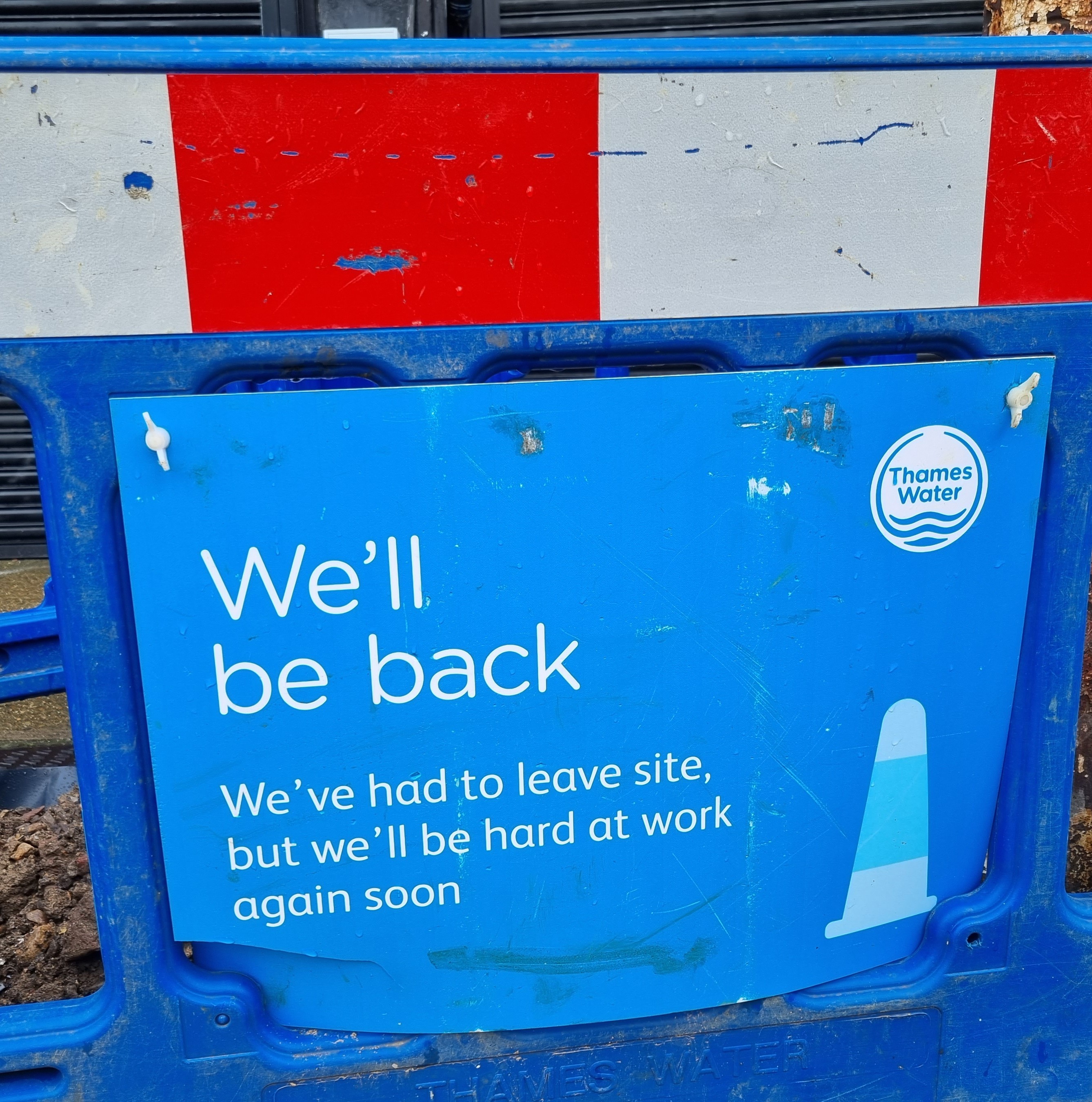
The first posts on water I put in the series of hand-baked from locally sourced ingredients. But that won’t do for the ones I’ll soon be writing because they are made from imported ingredients. I’m just saying really that I don’t know how to organise all this and make it accessible. It’s not really very bloggish. But as the bloke from Thames Water said when I asked him why they were digging up the road again – I swear they’ve dug up one section or another fifty or sixty times in the last 25 years, honestly, I’m not joking: “well, it keeps us in work”. Me too.

Meanwhile my thoughts on gardening have rather dried up, what with the heatwave and drought, then floods, then ice and snow, then more rain: everybody was saying, isn’t it beautiful, and I just saw death in the garden: too many tender things, and feeling tender myself. But I will have more to write about plants and gardens later.
now it’s 2022 and I’m not sure whether to put this edit to ‘about me’ before or after what comes below. I’ve never quite got used to the way chains of emails and messages and blog posts begin now and work backwards, so they begin at the end, which is of course a new beginning, and books go the other way.
But what I want to say is that I’ve been thinking about some of my old posts, which are by now buried deep, and I would like to bring some of them to your attention. Let’s start with Bomber Harris. His statue still stands outside the RAF church in the Strand. And the war memorial at Hyde Park Corner to the machine gunners which boasts about how many people can be killed with machine guns. See remembering and forgetting, the bombing of Dresden And back on familiar ground . And even though the hoardings around the Shell site development at Waterloo are long gone I’m still angry about their shameless display of child-exploiting nonsense. See new outrage in SE1 and searching for vibrant, august 2017.
To tell you something of the story behind the series of posts I am writing at the moment (during the famous 2020 lockdown) about plants and gardens –
(if you click on ‘gardens’ in ‘categories’ you will find all the Garden Notes – )
I began gardening in the 1970’s at Laurieston Hall, a commune in south west Scotland. The first things I learnt about were composting and weeds.
For about twenty years I worked in private gardens in north London. There I learnt about flowers and shrubs and what other people want.
For ten years I worked for St Mungo’s, the charity for homeless people, in their gardening project, Putting Down Roots. I still work – though not at the moment – in one of our old places, St John’s churchyard in Waterloo. There I learnt, and am still learning about the two kinds of community garden, that of plants and that of people, and how they connect.
And I have my own garden, which is open sometimes under the National Garden Scheme. I had a date for the end of May this year, but now I hope maybe to open in the autumn instead. There is always cake, and plants for sale.
Thirdly, when I retired from St Mungo’s in 2012 I started working part-time again at G., more of an estate than a garden, in the green belt on the edge of London. With my old apprentice, friend and partner Jamie and quite a few others we began to rip out, reform, lay out, plant and prune about twenty years ago, he carried on full-time with the freedom to indulge his love of plants when I went to St Mungo’s, glad to be out of business, and now it often feels as if I’m the apprentice.
I feel very lucky to be connected with these three gardens, all in the same city but with different soils, micro-climates and communities, (in both senses.)
I’ve walked in the Alps and in the Himalayas (I would love to brave the leeches and see the monsoon flora but I think I’m too old and no longer tough enough.) In the last few years I’ve fallen in love with the mountains of Greece. They talk about ‘the trip of a lifetime’, but I always want another one. And another spring.
All of this informs my Garden Notes, and you’ll find posts about Greece, the Alps – oh, and Scotland! – if you use the menu.


 like a little black book