
I have had to hunt for this image from a photograph I took in 2012 in a gallery in Siena. Years ago I copied/uploaded it from my computer onto Photobox and used prints from their site make christmas cards. Sometimes though Photobox would take not just a copy but the whole thing, the original thing, and refuse to give them back. Sometimes with right clicking you could find a way to make it let go, other times no. Even if you could persuade them to give something back it was an inferior version. But what we have here is an even more inferior version: this is a photo I took with my smartphone of a version of the picture on the photobox website, which I then put onto my computer and from there onto the wordpress website which I use for my blog. The reason I’m telling you this is firstly to apologise for the poor quality of the image, which doesn’t matter much because it’s a powerful image, it’s a weak and powerful baby, but secondly to show that I am having to work at this, that there is work in remembering, in holding on to things, and also that forgetting and remembering go hand in hand.
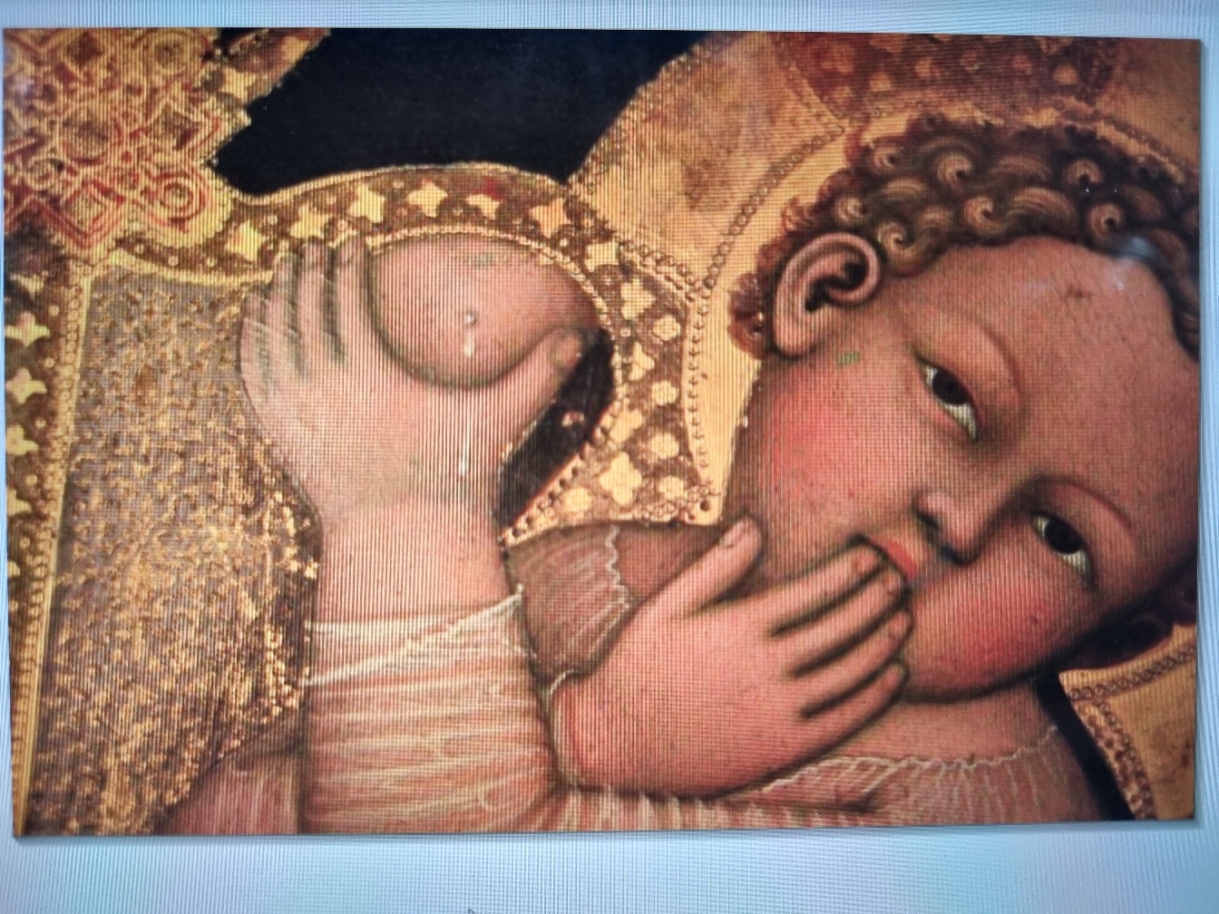
Here’s baby Jesus. He might be the most famous baby of them all. For the moment he’s happy, and he has no interest at all in gold, frankincense or the bitter perfume of myrrh. Tomorrow Herod’s men will kill all the baby boys they can find, but Jesus will escape with his parents, through Gaza into Egypt.
Is this in some sense a continuation or an echo of the slaughter of the Egyptian first born when Moses led the Israelites to freedom? Religious leaders fit bloody bones into patterns to explain the purpose of their God. And now I see for the first time a crucial part of the story, one which is not celebrated or even explained except possibly by the most furious of fundamentalists: after each of the plagues Pharaoh, appalled, agreed to let the children of Israel go, but God himself, because he felt that the Egyptians had not yet been punished enough, because he wanted his triumph to be magnificently horrible, God hardened Pharaoh’s heart and made him change his mind. It’s all in the Book of Exodus.
After the great firestorm, the first of its kind, deliberately brought about by a combination of high explosives and incendiary devices in the mass bombing of Hamburg in 1943, which is estimated to have killed 40,000 people, a million fled.
Friedrich Reck, in a diary entry for August 1943 describes a group of refugees from Hamburg trying to force their way onto a train at a station in Bavaria. As they do so a cardboard suitcase
‘falls on the platform, bursts open and spills its contents. Toys, a manicure case, singed underwear. And last of all, the roasted corpse of a child, shrunk like a mummy…’
Act 3, scene 3 of Shakespeare’s Henry V – Laurence Olivier’s Henry V, brilliant piece of British wartime propaganda, which was being filmed in neutral Ireland at the same time as the bombing of Hamburg – was redacted. In it Henry confronts the governor of the besieged town of Harfleur and tells him what will happen if he refuses to surrender. He will lose all control of his men and they will loot, rape and murder: why, in a moment look to see / the blind and bloody soldier with foul hand / defile the locks of your shrill-shrieking daughters / your fathers taken by the silver beards, / and their most reverend heads dashed to the walls ; / your naked infants spitted upon pikes (and now for the climax of this terrifying speech it’s christmas again – ) whiles the mad mothers with their howls confused / do break the clouds, as did the wives of Jewry / at Herod’s bloody hunting slaughtermen.
Patriots may say, this was a standard medieval threat, but doesn’t Henry enjoy it! I would have him advance on the shaking governor while delivering these lines – and there are many more – until the two of them are so close that Henry might be about to head butt him. You’ll be pleased to hear that the governor follows Henry’s advice, and surrenders. Tony Tanner, in Prefaces to Shakespeare points out that Holinshed, the main source for this play, says that after the town was surrendered the English sacked it anyway.
see also remembering and forgetting, the bombing of Dresden , more on Germany and the war and photos from Germany (hear the truth whoever speaks it)
You could imagine hopefully that it’s like a huge spread sheet, get all the facts laid out in order and a balanced truth will appear, balance the burnt babies against the legitimate strategic targets etc. But of course in the end we believe what we want to believe. Bomber Harris still stands on his plinth outside the church of St Clement Danes in the Strand:

Strange – he’s escaped the statue toppling. He was placed here and unveiled by the Queen Mother in 1992 on the anniversary of the great 1000 bomber raid on Cologne. He was vandalised a few times, but cleaned up again, and eventually forgotten, it seems, ignored. Poor Arthur. After the war he didn’t get the recognition he deserved. He felt that the snivelling pacifists had stopped him from being ennobled. He remained Sir Arthur. He went off to South Africa and became a businessman. I didn’t want to prolong this piece but one of Harris’ critics, during the war as well as after, was Canon Collins, later to become better known for his opposition to apartheid and his prominence in the Committee of 100 and CND. In the nominally christian west there have always been a few real christians – the true followers of baby Jesus if you like – who have made life difficult for slave owners, tyrants, warmongers, racists, and the ruthless exploiters of people and planet. I remember the sneering of the Sun at the bleeding hearts, people who, for example, thought that prisons might be places for reform, not simply punishment. In fact that image, that phrase – my heart bleeds for you: it’s only used sarcastically now, isn’t it?
Years ago when I was finding out about the bombing of Dresden I came across a photo on the internet of a group of dead people sitting in an air raid shelter. They’d been asphyxiated by the lack of oxygen; they had the perfection of waxworks. One of them, I remember, was wearing a fine tweed suit. I then realised that this was a neo-Nazi website, and the firestorm that consumed Dresden was referred to as the real holocaust. So the one with a capital H was unreal, I suppose. And when I talked to someone at work about Dresden, he jumped into an argument straight away: he knew that David Irving and others had exaggerated the number of dead. They claimed it was a 100,000, but it was many fewer. No one really knows. After the war the DDR – it became like guess the weight at a funfair – put forward a figure of 200,000, to include large numbers of refugees who might or might not have been sheltering in the city at the time. I will stop now, and I know that for most people in Germany and here it doesn’t matter that much any more, but it keeps going round and round in my head: just one more thing: the bombing raid most celebrated in this country is the Dam Busters Raid. Quite jolly really, bit like Ghost Busters. The triumph of strategic bombing, the clinical precision, the courage of the aircrews, the ingenuity of the engineers, the clean blow against the Nazi war machine. In the little park over the road where I used to walk the dog more than twenty years ago I used sometimes to chat to a grumpy old German woman, married to a grumpy old Pole. She remembered in the aftermath of the raid, in the floods rushing down the valley, the bodies of the drowned. I looked it up. There were 1,293 of them. Two more things. The balance sheet. Some say that, while German industrial production actually went on increasing until remarkably late in the war, thanks to fanatical hard work and three million slaves and factories built into tunnels deep inside mountains etc., the biggest contribution of the bombing campaign to the war effort could well be that improved German air defences were achieved by the withdrawal of planes and artillery from the eastern front thereby helping the more speedy advance of the Russians and putting a quicker end to the death camps in the east. A baby killed here, a baby saved there.
This is a little verse I wrote while on steroids. Coleridge and opium, me and – what’s it’s called – I’ll have to look it up – prednisolone. I’ve had attacks of extreme breathlessness. I recommend it, but don’t stay on it for long.
How cute are coots! / They skate and scoot / but cannot ever play the flute / in fact they’re mute
That’s not true of course. Ah, the simple pleasure I took in making something up. Then I told this verse to a little girl who was most appreciative and said it reminded her of Mr Magnolia who had only one boot! High praise! happy christmas.


 like a little black book