It’s as if the subjects of the garden have been subjected to a citizenship test, a freeze and thaw torture which has exposed the illegals. The plectranthus now are scarecrows, cobweb grey; their dead tissues flop, inert, unless stirred by the cold breeze.
But how silly to view Nature as a collection of Aesopian morality tales. Remember the industrious ant and the frivolous grasshopper? The Dickensian-style cruelty of the ant who would not give shelter to the grasshopper when winter came, when the party was over?
In fact grasshoppers are busy all summer. They eat a lot to feed their elaborate journey to maturity, pupating five times, each time growing a little closer, and when they properly become adult they mate, of course, carry on eating, and then after two months, die. But the eggs, which the female buries in the ground with her ovipositor, live on. If only I could be an egg now.
That idea of the citizenship test reminded me of the story from the French revolution, how aristocrats in hiding could dirty their faces and put on rags but they couldn’t harden their hands, their soft flesh spoke of privilege and decadence and gave them away. I used to take a secret pride, I think, in my own hands calloused from gardening, with their creases and wrinkles often highlighted by stubborn dirt even after scrubbing; I never wore gloves except in the coldest weather. Now my hands are bourgeois pale pink, the hard pads at the base of the fingers have shrunk almost to nothing and any scratches or cuts that I do get from my much more infrequent garden labouring are slow to heal. And the nails! They grow so fast and break easily.
a detail in Updike’s Rabbit Run struck me vividly when I read it thirty years ago:
Harry gets a part-time job in Mrs Smith’s garden – her ‘acres’. An unlikely associate, a minister of religion, thought it would be good for him. He has never done any gardening before. Rapture, both celestial and earth-bound, opens the chapter. Updike soon moves from rapture to comedy, from an awareness, situated in Harry’s work, of the detail of soil and leaf, to Mrs Smith’s resentment at being landed upon the death of her husband with his collector’s obsession with rhododendrons when she would actually rather just have turned the whole place over to the growing of alfalfa, coming from a farming family herself. She speaks of her perpetual irritation with Mrs Foster who would always visit at rhododendron time and coo – ‘with lipstick half way up to her nose’ – “My, Mrs Smith, this must be what Heaven is like!” which makes Mrs Smith reply one year that if that is the case she doesn’t know why she wastes so much time every sunday driving six miles to the Episcopalian church. But one rhododendron she does seem to love. ‘They stop at a corner and she lifts her dangling cane toward a small rhododendron clothed in a pink of penetrating beauty. “Harry’s Bianchi,”’ Mrs Smith says. Her husband was Horace, so his short name is the same as Harry Angstrom’s, whose short name is Rabbit. And this rhody is the only true pink there is, and it was brought over from England at great expense, a man had to go down into the hold of the ship every day to water it. It makes all the other so-called pink rhodies look just muddy. So Mrs Smith, while depising the general obsession, shares her husband’s idealising love for this particular variety, which she claims is the only one in the whole of the United States. I looked it up. Itr was a favourite of Gertrude Jekyll and is still for sale. At the end of the passage we return to that favourite gardening theme, paradise: Rabbit, unusually sensitive and accomodating, suggests that if Alma Foster, who passed away two years ago, now sees celestial rhododendrons, for Mrs Smith the same vision might appear to be alfalfa. She is delighted with this thought, and that’s the last we hear of her, as Rabbit goes back to the messy struggle of his life.
But this is the detail that I went looking for: ‘Funny, for these two months he never has to cut his finger nails’. That is an extraordinary piece of esoteric knowledge! I’m not well read in novels, but I can’t think of another novelist who could have come up with such a telling statement.
Now I have to cut my finger nails frequently, and they’re so soft that they break easily. They used to be like miniature trowels, good for delicate digging, feeling for buried roots. I very rarely wore gloves, couldn’t work properly with them. There were times when I could hardly type properly, if I had painful cuts on my finger tips, making it extra difficult to be both a manual and an intellectual worker. For some reason I got to talking about hands and strength and ageing with D. the builder this morning. When I say these two chest infections made my copd so much worse, made me so breathless, I got out of breath just walking to the bus stop to go to the doctor’s, he says, not for the first time, that’s what my dad died of. He used to smoke sixty a day. Showed D. my hands, he said, yeah, they’re soft. Like a woman’s. The hard pads at the base of my fingers have almost disappeared. In Bridport the other day I spoke with P. briefly about his work in the bell factory. He does the woodwork, wheels and pulleys and frames. He’s been making a wheel out of three kinds of wood, ash, oak an chestnut. They each have a different role. Oak for the spokes, for its strength, ash which is easily steamed and bent for the rim, and then I think a kind of outer rim of chestnut. We shook hands when he left, and that took me back to an old man I met in Greece a few years ago, by the roadside at the back of Mount Olympus. I had stopped the car and scrambled up a bank; he came walking down from the village, leaning on his stick, and we waved to each other. Just after I’d got back in the car – why did I? – he came up and we chatted, I with my small handful of words: walk, flowers, beautiful, he seemed to like them, and then he put his big fist of a hand in through the car window. Thick fingers, the same warm, dry strength, and his skin – I can’t find a word for it at the moment, not rough, but not soft, not smooth, a warm thickness of skin, maybe like the finest sandpaper you can imagine, the kind a carpenter might use to give a final polish, so fine that you can rub away with it for ages to make the wood only a little more silky. The same friendly handshake. Sometimes a handshake can feel so brief, slithery almost, the skin with a soft, moist clamminess, made worse maybe by the embarrassment of the old formality, and the hand you touch is like something you’ve caught hold of but shouldn’t have touched, and it’s in a big hurry to get away. No wonder handshakes are almost extinct. But a good one is a precious thing, almost.
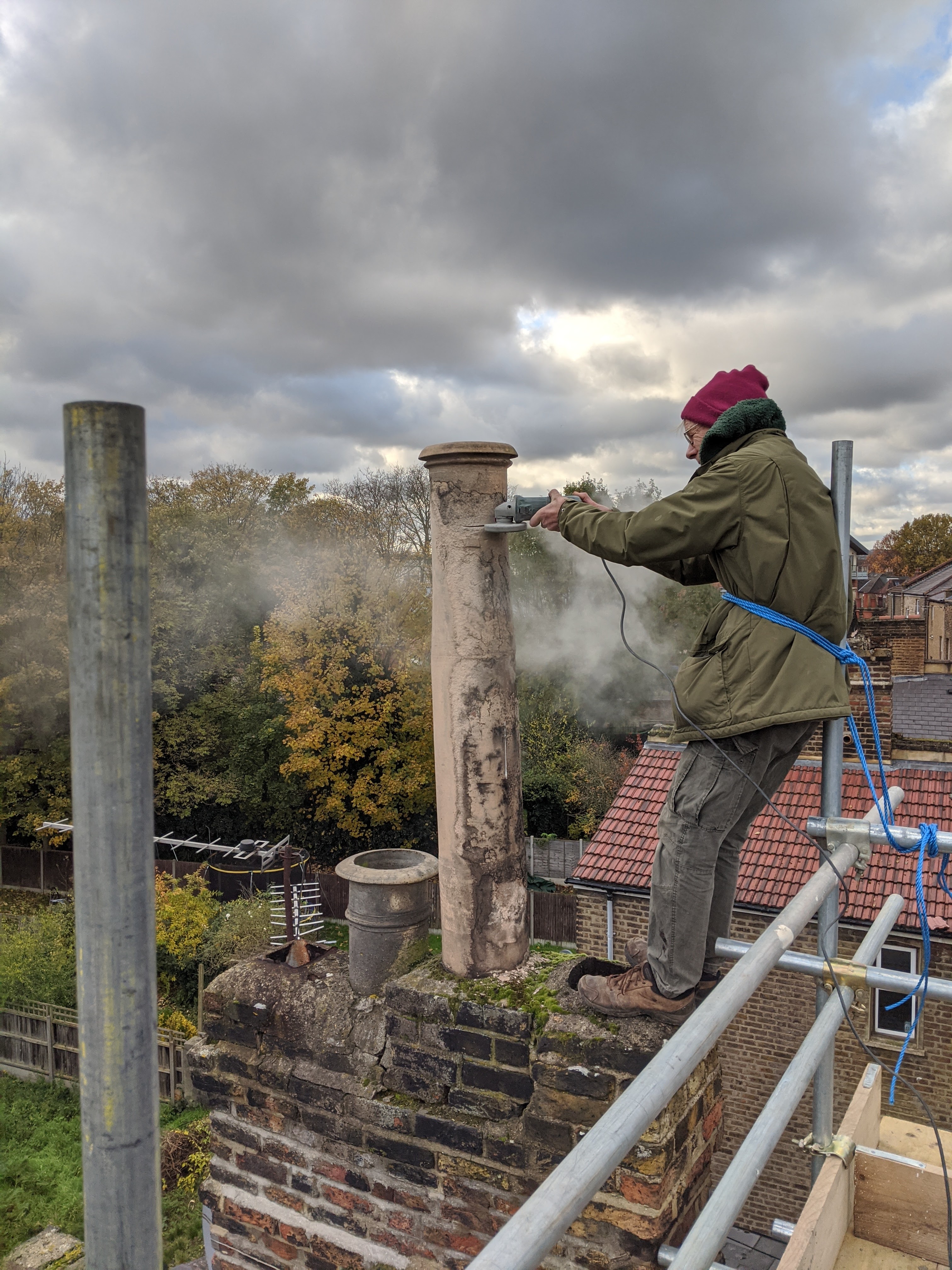
Some silly things I used to do before I lost so much of my strength and boldness. There was a tall single chimney at the back of the house, my silly cowboy roofers didn’t want to touch it – what’s the point of cowboys if they’re not even adventurous and agile? – but I thought we should take the chance to get rid of it because it was flaking away so I said all right let me use your angle grinder and I tied a rope round myself just in case and Paul took a photo of me. I did it in little slices because I didn’t want the whole thing to come crashing down.
It turns out also that Updike wrote some nice little poems about gardening, like this one:
I sometimes fear the younger generation
will be deprived
of the pleasures of hoeing;
there is no knowing
how many souls have been formed by this
simple exercise.
The dry earth like a great scab breaks,
revealing
moist-dark loam – the pea-root’s home,
a fertile wound perpetually healing.
How neatly the great weeds go under!
The blade chops the earth new.
Ignorant the wise boy who
has never rendered thus the world fecunder.
I’ll leave you with a few lines in a different mode, from the rapture with which the gardening chapter in Rabbit, Run begins, in early spring (page 110 in my old penguin edition): ‘…… and the earth itself, scumbled, stone-flecked, horny, raggedly patched with damp and dry, looks like the oldest and smells like the newest thing under Heaven.’


 like a little black book