
Pangaeo, 29th of May, 2019. It lies in south east Greece. The mountain is basically a long, quite narrow ridge from east to west, with several undistinguished summits and views south over the Aegean. Its name means all the Aegean, from the notion idea that you might be able to see the whole of that sea from its summit. A road runs for about 15 kilometres easily and gradually and erratically up it from the east, from the small town of Elepftheropoulis, which means Freedom town, a poor, empty road, cracked and rutted, as if in places it has survived minor earth tremors, probably though just as a result of neglect since the gradual failure of a short lived skiing resort. The top is only 1900 metres high. This road though is itself a delight, with many temptations for stops and walks along the way, grassy tracks lead to abandoned meadows in clearings, and the solitude and slowness of the journey made it seem like a little adventure itself, an episode in a pilgrimage, not merely another privileged motorist’s short cut, a too sudden translation to a new world. Uncut verges were full of flowers at the beginning of June. In the forest, so I have read, and I’ve seen the photos, is a clearing (to the left of the crossroads 5k from the very small village of Dasiko Horio, according to John Richards, which is about 6k above Elephtheropoulis,) filled in May with hundreds and hundreds of red paeonies, although I didn’t look carefully enough to find it and I knew that the paeonies would have finished flowering. But on limestone ledges among beech trees grew mats of Geranium macrorhizum, familiar from our gardens, and the common shade loving tall saxifrage, Saxifraga cuneifolium with its panicles of starry white flowers.

I did not meet a single car along the road, nor did I see a soul as I walked on the mountain, an exhilarating state of affairs unless you have an accident or get lost, as I did, though not seriously. There are parts of Europe that we no longer have any use for. There is no longer enough snow for ski-ing, on mountains which lack the sublime drama, the crags and precipices which walkers and climbers demand; there are no picturesque market towns, no peaceful yet lively bars or tempting boulangeries; no wild swimming in cool green pools in shaded rivers; no phone signal, empty spaces on google maps; no welcoming natives; no intimate camp sites or convenient Airbnb’s; even the herdsmen and their sheep and goats have gone; instead in ruinous villages where no one speaks english you sometimes meet with embarrassment the curious but suspicious stares of old men and women who have been left behind. I said exhilarating; so it was until I thought again.
The road gives out some way before the map and the books say it should, before the last rise to where the skiing station still might be. You would need a 4 by 4 to get you through deep tangled ruts and mud, but before the sudden end it runs for a couple of kilometres along the south side of a delightful plateau close to the Aegean, and this last section of the road is smooth and level. The only sign I saw of human activity was a radio or some other sort of telecommunications mast on one of the summits. No doubt its presence will ensure that the road does not become completely undone, unless satellites make it useless.
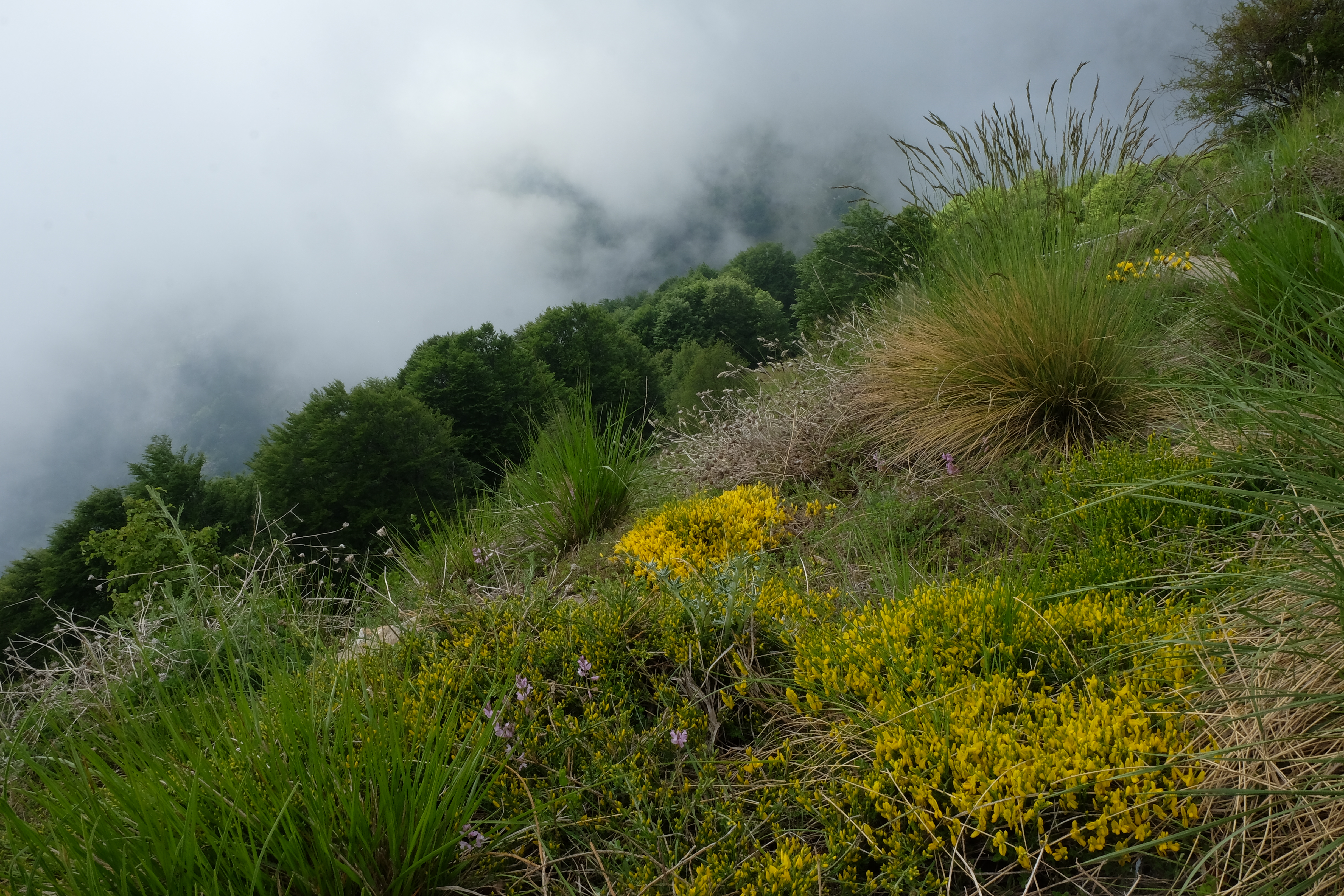
The mountain is made in part of white marble. To the right of the road are low shining cliffs, cut to make a ledge for it. The spoil from the right hand side has been dumped on the left to form, wherever the drop was not so steep that it all must have tumbled down, broad, level platforms of crushed rock. Sometimes all you need to make a garden are some power tools and a bulldozer. Maybe a few carefully placed small explosions. If you had a car that would take one you could then spin along in a wheelchair and see the best of the mountain up close, for on both sides of the road there grows a wonderful variety of flowers, many creeping out over the tarmac with no sign of a single leaf having been crushed by the wheel of a car.
On the platform to the left of the road:

Here are some plants on tarmac:


The marble of the low cliffs looked as if it had been violently shattered. Its chaotic nature evidently meant that no quarrying had taken place there. Here because recently exposed by the road makers the stone is milky white. Elsewhere its colour is dulled by what we sometimes call weathering, which could refer to the effects of smoky pollution or the growth of lichen. The almost two billion years old rocks of the Lewisian gneiss at Diabaig, by Loch Torridon are of an elephantine grey except close to the sea or, again, where they have been smashed by road builders, when they reveal soft pink and orange-brown.

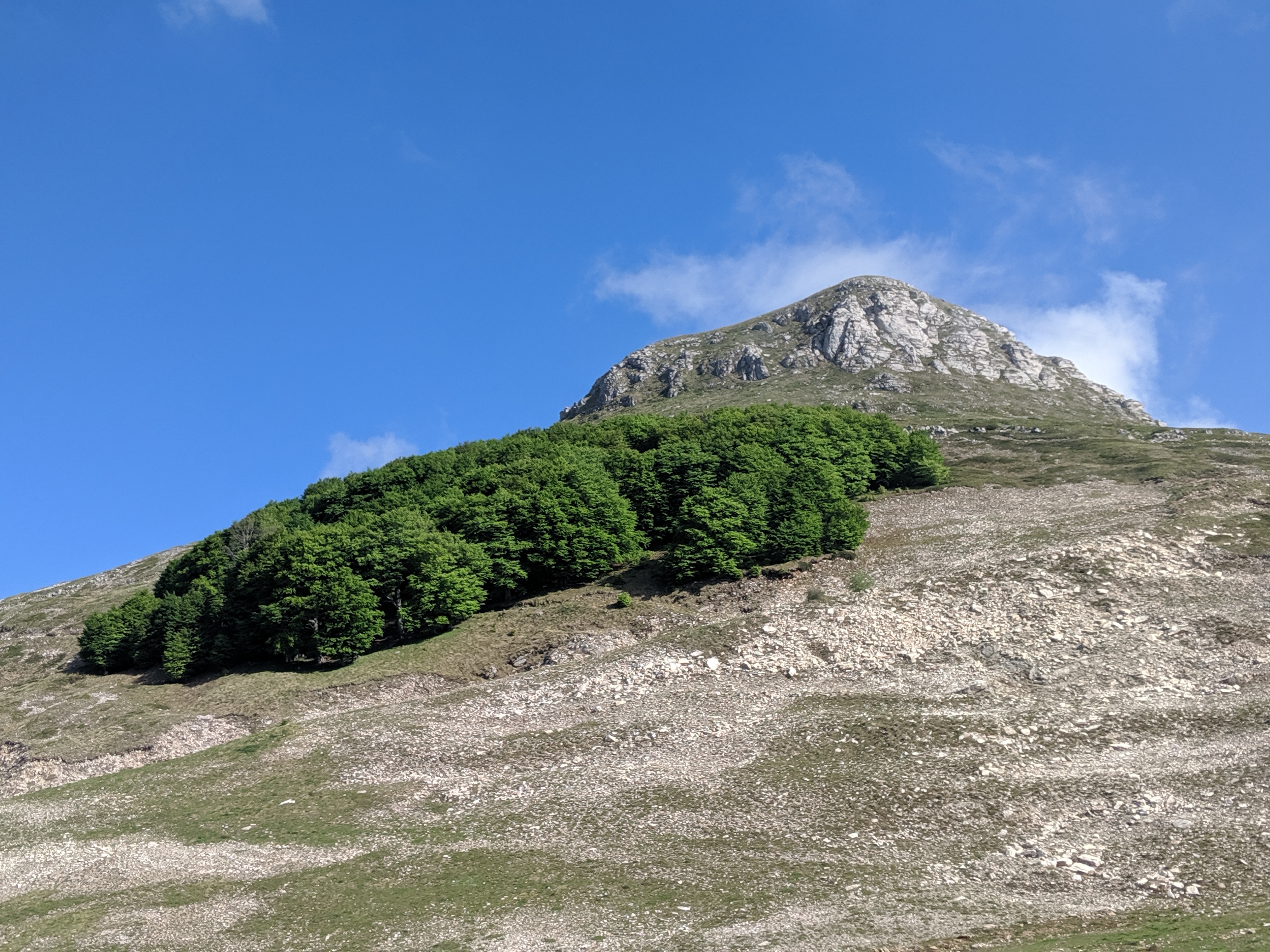
Several beech woods grew along and below the treeless rolling plateau. Lower down the road goes through beech also, before the forest of fir. I was surprised, we’re used to conifers being the highest trees, but shouldn’t be. In most of Europe beech is a mountain tree. We associate it with woods in the Chilterns and elsewhere on English chalklands, though they grow vigorously also in parts of northern Scotland. One beech wood in particular stood out from the treeless grassland around it by its density and compactness, like a plantation, reminding me of the little beech woods and copses that were planted on Salisbury plain in the 19th century; one arrangement of small groups of trees was laid out in imitation of the battle plan for Nelson’s fleet at the battle of Trafalgar, and this wood on Pangaeo also seemed somehow anomalous.
To the south where the sea lies it was hazy. I wouldn’t go all the way up Pangaeo for the views. Websites and brochures extol the always stunning views from greek mountains, but I have usually found them dim, though extensive, of course. The air in Scotland is usually much clearer, and the clouds more dramatic, and in the Alps too.


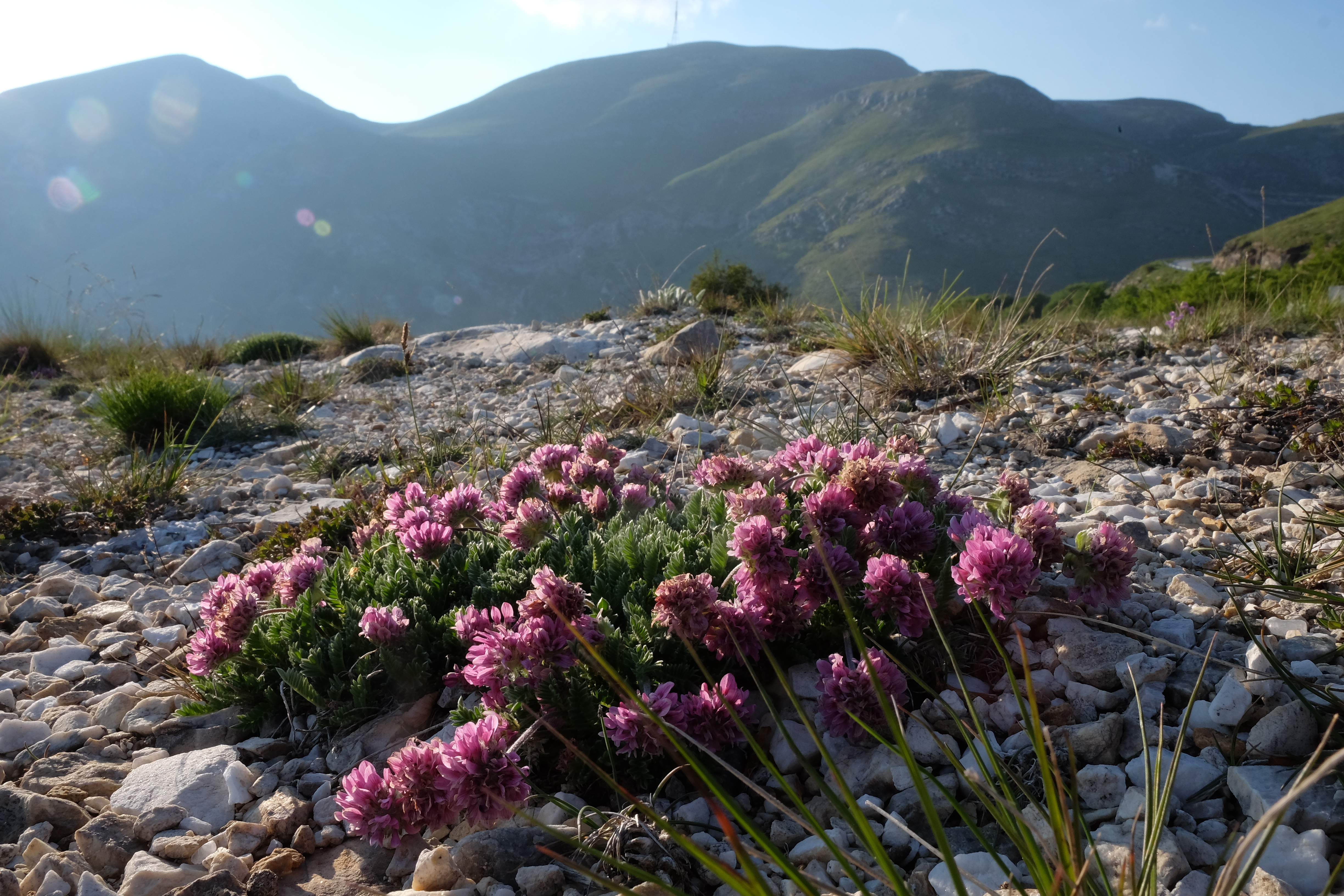
The end of the road lay quite near to a low rounded summit, one of two, and I decided to do a circuit of it, up in the gathering mist. Needless to say, this part of the day does not belong in the Easy Walks category, and there were no paths. I went up through quite thick grassland, (clearly this mountain was not regularly grazed, unlike some greek mountains which are grazed to the bone, as if even the shepherds had no use for it), broken in places by rock ledges, and came down again gradually, only seeing what lay close to me, confidently assuming I had completed a circuit, but when I got back to the road again I realised eventually that I had probably done one and a half circuits having navigated in a way which subsequently put me in mind of Winnie the Pooh. So going on was going back, and this allowed me to slowly retrace the route I had driven along the last section of the road. And the sun came out, low in the west. Crouching down, to the left of the road, I could see the flowers against the sea and the sky, their petals brightly back lit.

After a long day it was growing dark when I set off to drive back to Drama, and I got lost for the second time. In Freedomtown. Road signs in the country are the responsibility of the state and are usually fairly good, but signs in villages and towns are the responsibility of local municipalities and are sometimes non existent, and in the ancient jumble of narrow lanes and houses the through ways may not be at all obvious. In that way the structure of a village may be like that of the City of London which has kept its lanes and passageways for centuries between all the increasingly gargantuan offices and banks.
Now I’m trying to limit myself to just a few more photos, but it’s difficult.

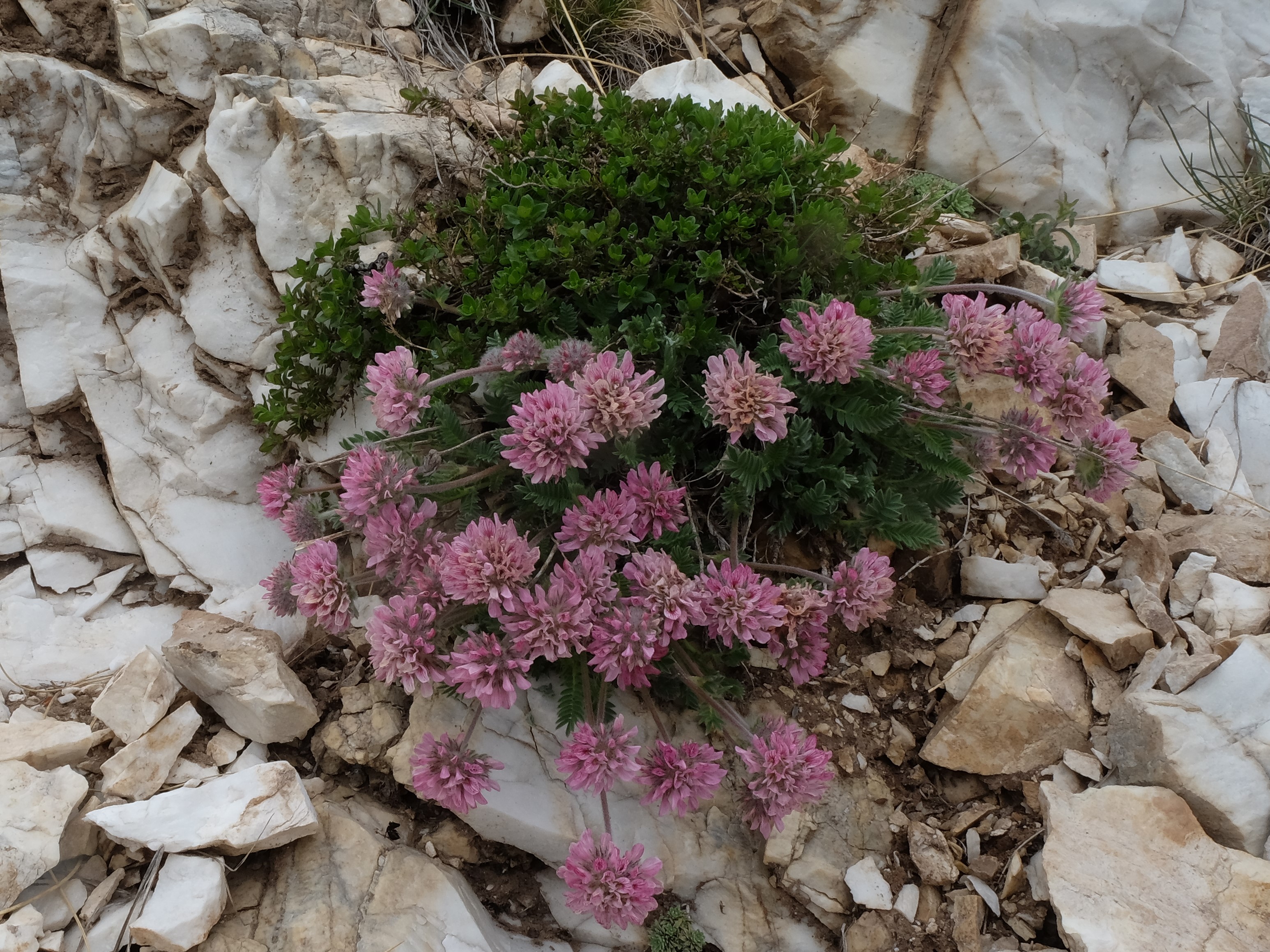


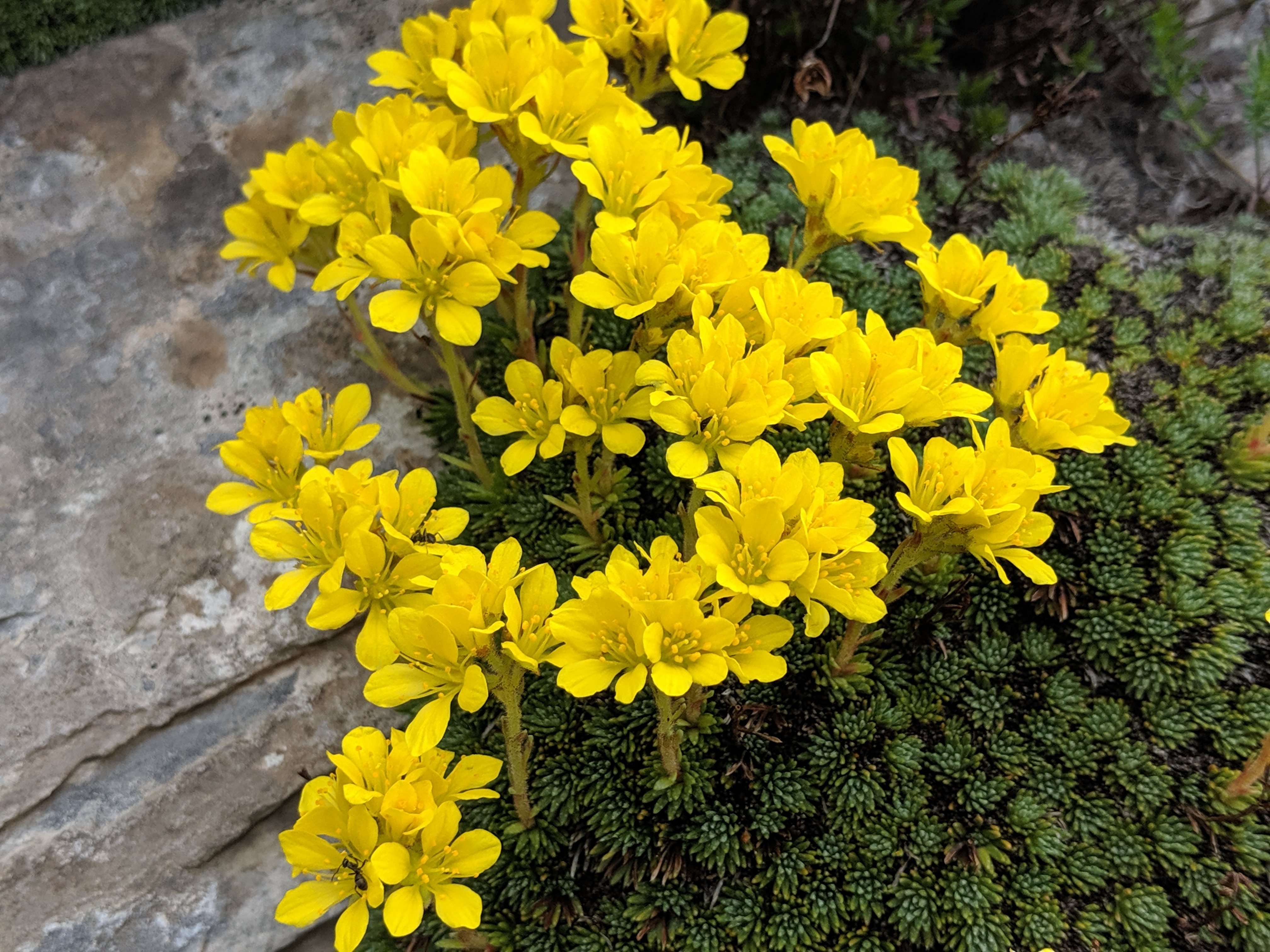

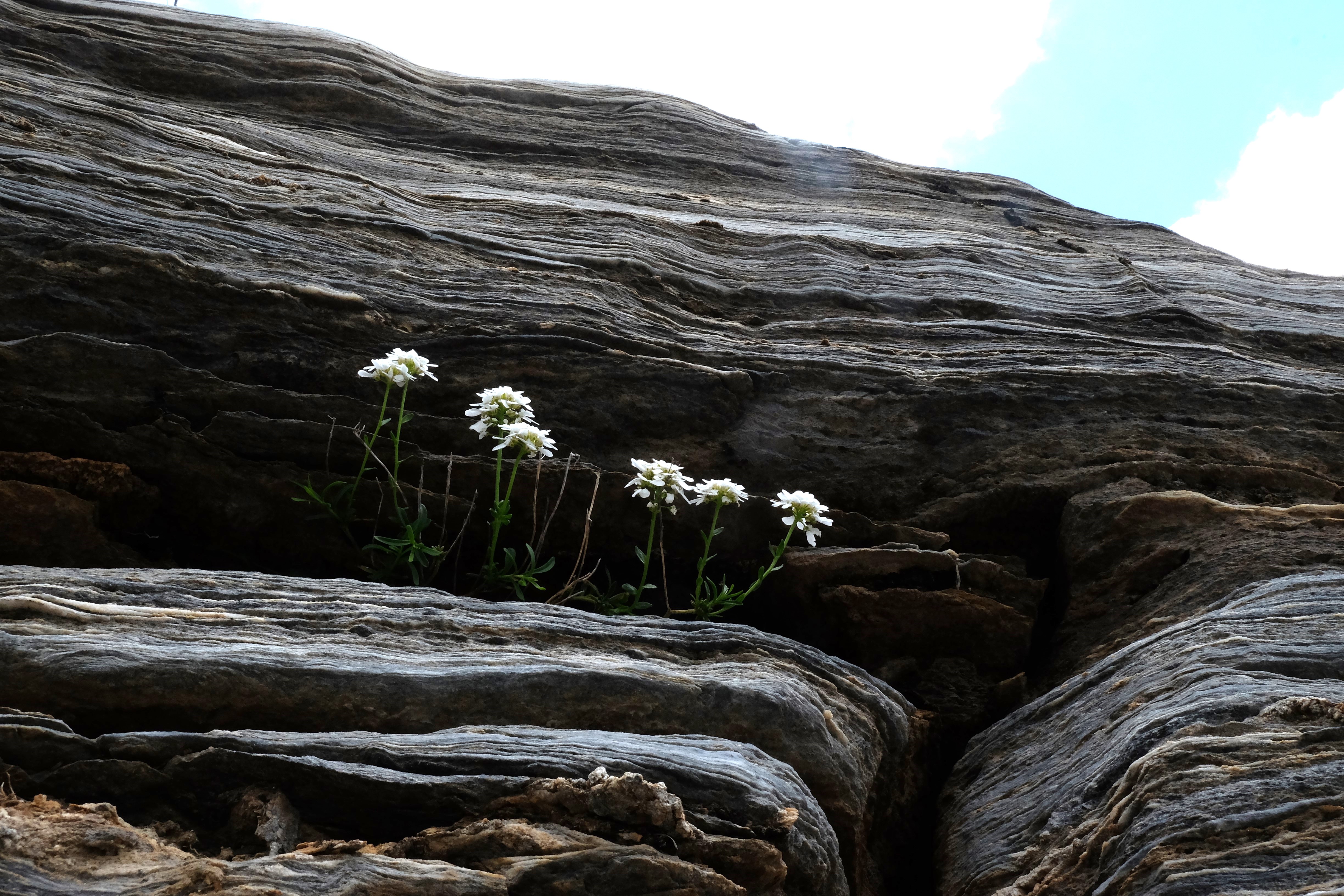

Although some of these photos were taken at quite a steep distance from the road, most of the flowers shown here – and others – can be seen from the road. And sometimes the views, if not ‘stunning’, getting lost in the mist is stunning, are given drama by what you might think of as moving northern weather: drifting cloud, sun and shade:

Now – a week or so later – I see from looking at the map that around my little conical peak which I’m reminded goes by the name of Avgo, egg, around the peak the road takes a turn to the north so that what I had assumed was the more or less long straight ridge of Pangaeo, and which appears in that view from the north, from Falakro as the stretched out rolling spine of a dinosaur, is in fact contorted and bent. With our eyes and in our minds we always try to make things more simple than they really are. So now I see that I might not have gone round the egg one and a half times, I might only have gone round half or three quarters of it before coming back down to the road. I will never know and it doesn’t matter, but still I find myself in a state of wonder about my whereabouts, and how easy it is to get lost with such confidence. I should have had a compass. I should always have one kind of compass or another. And then I remembered a journey that also will take me back to the theme of Easy Walks, though it’s not even a walk, but it’s an easy, exciting journey: on the Rhaetische Bahn in Switzerland, that travels through the mountains from the famous railway junction town of Chur south to St Moritz in the Engadine, and then further to Pontresina and up over the Bernina pass into Italy. At least twice the train as it climbs slowly up the side of a valley goes into a tunnel and when you emerge you find that the drop is now on the other side, and the world, which was already exciting, has become unsettling, you’ve lost your bearings, but of course you’re not lost in a mist, not made weak headed by altitude sickness, not tired cold hungry thirsty, you’re in the same comfortable, calm train, and through the window on the other side you see cattle grazing on steep hillsides, white streams silently flowing down, dark forest capped with cloud, floating specks of distant birds; and eventually I realised that although whilst in the tunnel you have no sense of turning, the train has in fact been spiralling up in the dark, that you have gone through a turn of 180 degrees, or even 540 degrees, so that not only has the view moved to the other side of the train but you are also going backwards, heading north again towards Chur, at least until the next tunnel. In my carriage of the train there was a big picture window which was disappointingly shut fast, until a local pressed a button and it began to slide open, a gift from the past in our new world of sealed trains, bringing the slow moving countryside, including foxgloves and big frothy white flower spikes of Aruncus dioicus – Grows in mountain woods and along shady stream-sides from central Europe to China and Japan, also North America. A superb plant, says Beth Chatto – bringing the woods and meadows and flowers up close, so close and so nicely slow that you might see how that train journey could be included here amongst my Easy Flower Walks in the Mountains. I once saw a post on the Alpine Garden Society er – what do you call it when people just contribute with their pictures and their comments and questions, and answer each other and correct and praise each other: oh yes, the pleasure of remembering, it’s a forum of course, a name helpfully derived from the latin word for a town square or market place – the AGS abolished this forum, they said because it was little used although I never had that impression, more likely I thought because too many fools wrote in, or if not fools then the naïve and ignorant, and by abolishing these pages the committee were able to take possession of the site for experts again and were saved the work of moderating and policing – this post I remember consisted of poor photos of common plants that were taken through a train window in the Swiss Alps. And I remember now as well that on that same journey to the Engadine I chatted to a happily evangelical Swiss woman who was blessed in the Lord and who told me that if I too believed then my copd, which had been diagnosed just a couple of years previously, would be cured.
Pangaeo is in Thrace, east of Thessaloniki, going towards Turkey, near the northern shore of the Aegean. The town of Drama is a good place to stay. You can read about it here: Drama. This post also says something about the subject for Easy Walks No 2, Falakro, the mountain on the other side of Drama from Pangaeo. And I remember now that I have already written something about Pangaeon here: stepping aside from Olympus…. in a post about weeds, waste ground, roadsides which was surprisingly good, I thought, when I looked at it just now.


 like a little black book