Whenever I try to get closer to my intended, far away subject, the cisterns, springs, water mills, rainstorms, fountains and floods of Greece, and their counterpart, drought and fire, Thames Water keep tripping me up.
Just to get them out of the way for the time being – oh and guess what, a few weeks ago they sent me a bill for £996, as if they think that I should be personally responsible for some of their excavations in my street. They said, terribly sorry, there’s been a problem with your direct debit, we’ve not been collecting any money from you for some time. But please pay up otherwise we will have to get our debt collection agency on the case. Meanwhile they continue to be very busy in my neighbourhood.


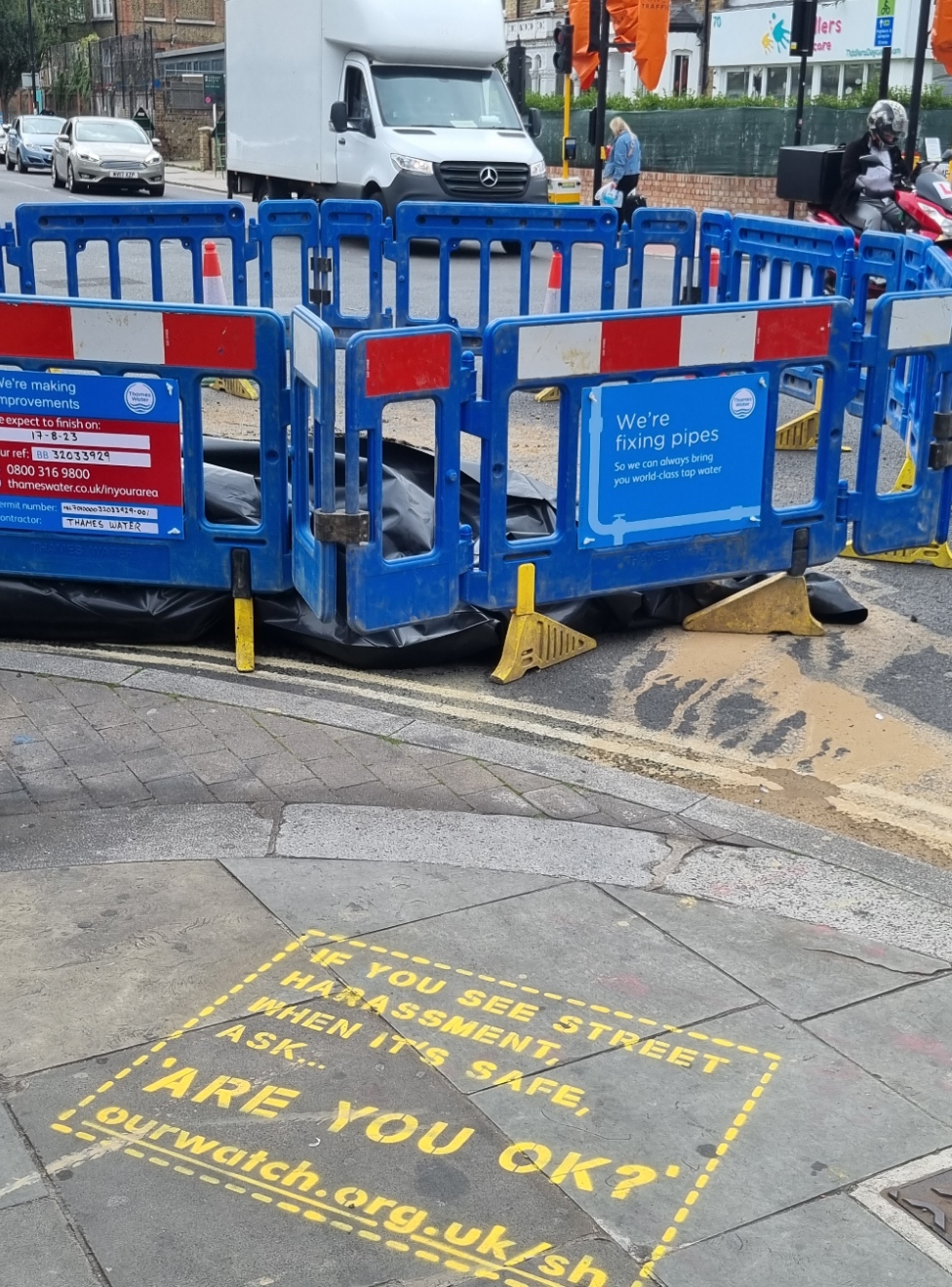
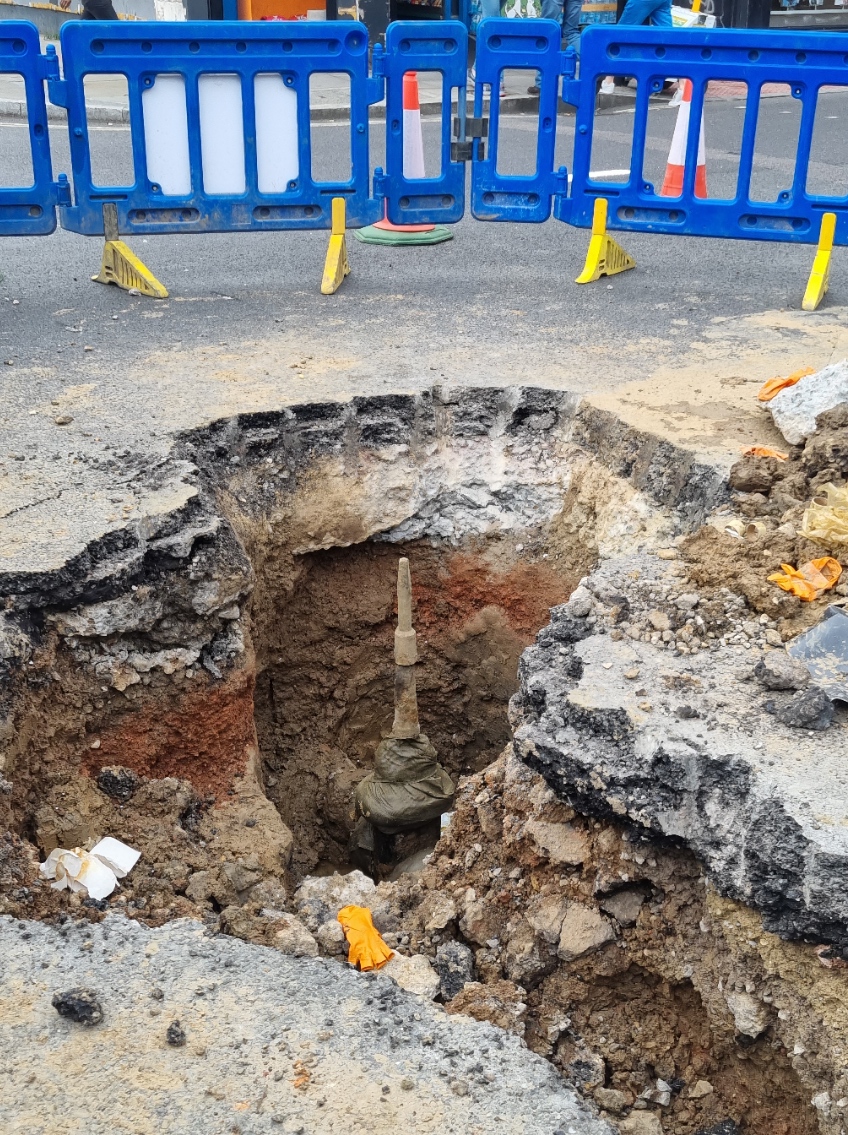


We’ll be back is my favourite. I gave Daniel the builder an I’ll be back christmas T shirt and I said maybe you don’t come back when you say you will because you’ve got some work with Thames Water. He laughed. Well, he smiled.
There are more interesting though much less conspicuous things to be seen on the streets.

In the gutter round the corner, this is chicory, with nettle and dandelion and a covid era face mask.
But a great disappointment in Allens Gardens (the little park over the road). Many blackberries were ripening in a thick, high, tangled bank against the railway line. I had pruned back the long new shoots which made it difficult to get at the fruits, leaving enough of them to develop fruiting side shoots next year. I’d picked them twice, they were big and juicy, and there were still more to come. But they’d been at them with hedge cutters and strimmers, destroyed the whole lot. The council don’t have much money to spend on minor parks, all they can do is cut the grass, if it grows, cut back the tangles of brushwood and bindweed that develop under the trees, trim the hedges and ‘shape’ the odd shrub by reducing it to some odd imagined ideal shrub shape: short, squat, square, starved. It does sometimes appear that you need to hate plants to do that kind of work, but that’s over dramatic: it’s enough to be indifferent. But they could have waited a couple of weeks for the blackberries. I imagined the shredded stems and leaves dripping with spilt purple juices. I walk along the little paths that wind through the trees and shrubs sometimes with my secateurs, snipping away at nettles and brambles that cut across the paths. It just needs a little gentle care, usually, ok maybe much more dramatic intervention once a year. The trouble is, I start to have a sense of, not ownership, stewardship maybe. I need to let go.
And down the end of our road – well, do you remember this? – The Selby rail crash (also known as the Great Heck Rail Crash) was a high-speed rail crash that occurred at Great Heck near Selby, North Yorkshire, England, on the morning of 28 February 2001.[1] An InterCity 225 passenger train operated by Great North Eastern Railway (GNER) travelling from Newcastle to London collided with a Land Rover Defender which had crashed down a motorway embankment onto the railway line. It was consequently derailed into the path of an oncoming freight train, colliding at an estimated closing speed of 142 mph (229 km/h). Ten people were killed, including the drivers of both trains involved, and 82 were seriously injured. It remains the worst rail disaster of the 21st century in the United Kingdom.[ci
You probably don’t remember. Anyway, I’m sure that it was soon after this crash that massive concrete blocks were placed on the pavement, where the railway line, poorly protected, goes underneath the junction of Manor road and Stamford Hill. They probably thought of it as a temporary solution, but those blocks are still there. Do people notice?


Notice how in the first picture the concrete block seems to be slowly working its way down through the pavement, suggesting a different kind of crash onto the railway line.
But look, there’s something beautiful! Our native clematis, old man’s beard, is growing there:

|And a real surprise, something I hadn’t noticed until today, even though that corner is also the site of some of Thames Water’s most exciting work. (See Water again, fresh excavations. for an illustration of the extraordinary things that happen underground – and incidentally, of impressive care for tree roots on the part of Thames Water’s contractors.)

These are suckers from the surviving roots of long forgotten elm trees which must have died in the 1970’s!

On the subject of things forgotten: the other day, at the other end of the road, up near Blackstock road I saw from the top of a 106 bus a few sparrows flitting in and out of some bushes. The first sparrows I’ve seen round here for a long time.
Where Manor road and the railway line form a narrow angle, just next to the concrete blocks, is a hideous advertising hoarding. It too was unsafe, blew down in a gale and was fixed, but not very well.

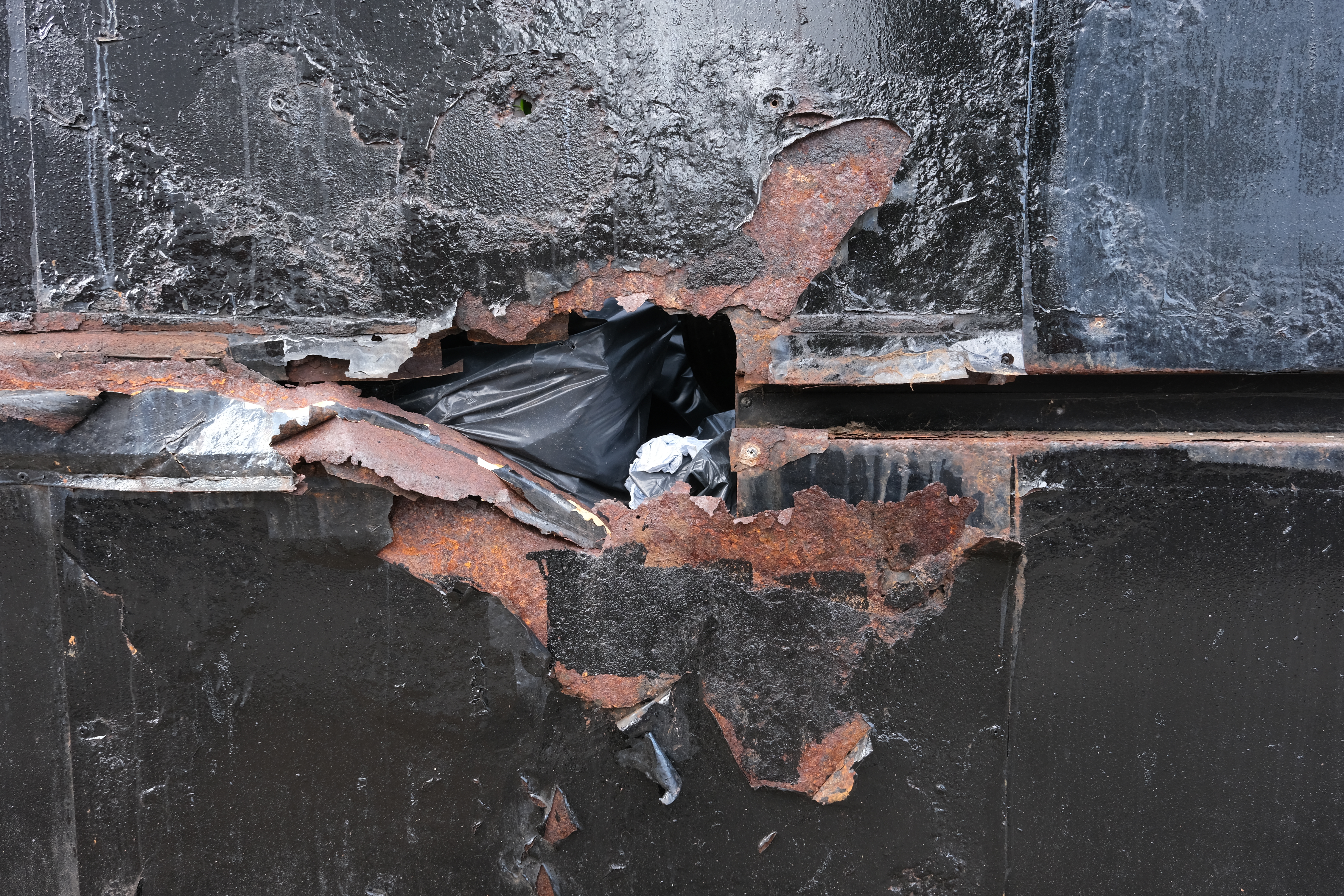


Flakes of rust accumulate on the pavement. You can pick at it just with your finger nails and bits fall off. Through that rusty hole you can see some of the rubbish that has been thrown onto the railway embankment.
But that’s all for now. I became down hearted when I tried to link this up with another post, I found what I was looking for, I thought, that’s quite good! and then it just seemed to disappear before my eyes when I tried to add a tag to it. What do you think is safest, paper or electronic. Or neither?


 like a little black book